One of the most common questions golfers ask when reviewing their Handicap Index is: “What should I actually be scoring?” If you are a 15-handicap, does that mean you should shoot 87 on a par-72 course every time you play?
The short answer is no. A golf handicap is not a simple average of your scores. It is a mathematical measurement of your demonstrated potential. However, thanks to massive datasets from shot-tracking technologies and governing bodies, we can establish highly accurate benchmarks for what different handicap levels typically shoot.
In this guide, we break down the latest available data on the average golf score by handicap level, explain why your actual scores rarely match your handicap exactly, and show you how to interpret your own scoring performance.
What Is the Typical Score for Different Handicap Levels?
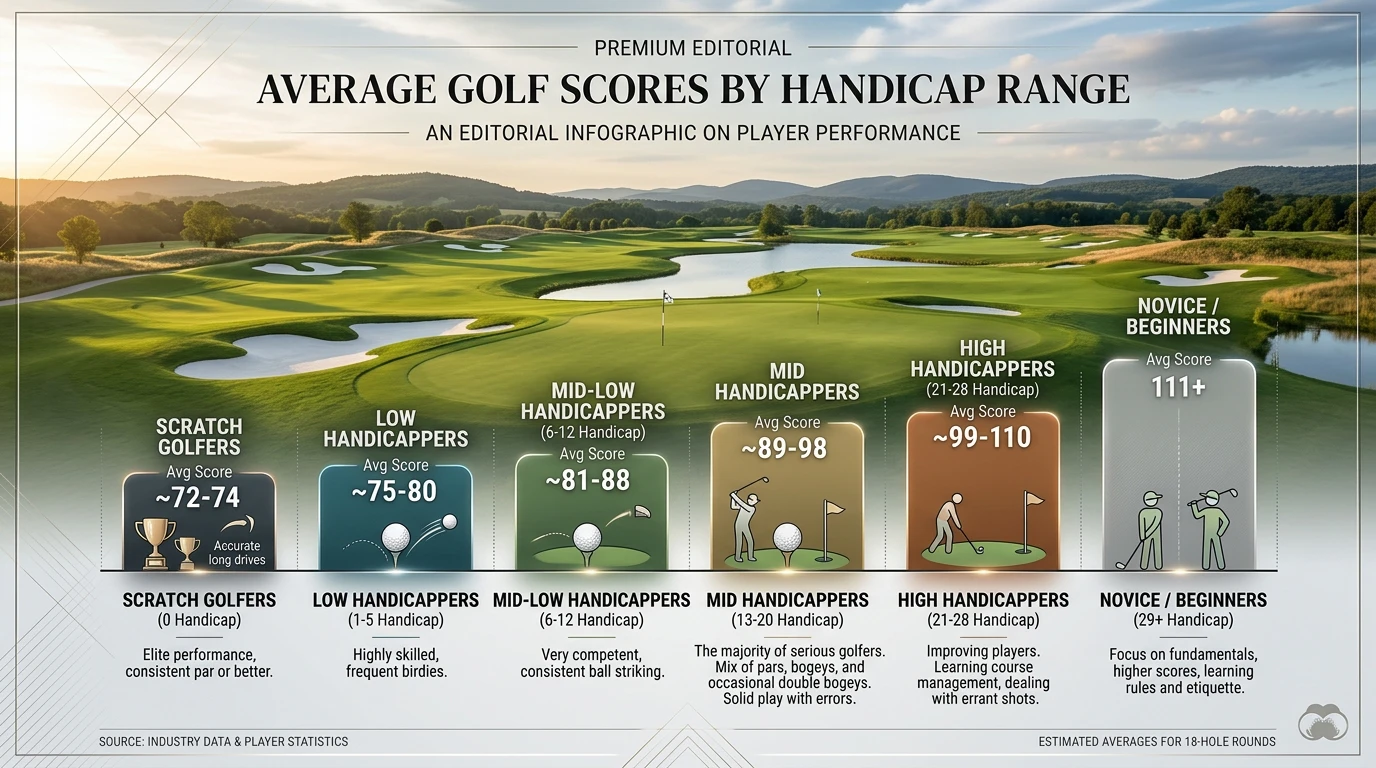
To understand typical scoring averages, we must look at actual recorded gross scores rather than theoretical mathematics. According to extensive statistical research published by Arccos Golf (which analyzes millions of amateur rounds globally), we can see a clear correlation between Handicap Index ranges and actual average gross scores.
The following table presents the typical scoring averages for male amateur golfers across different handicap brackets based on this data:
| Handicap Level | Average Gross Score (18 Holes) |
|---|---|
| Scratch (0.0) | 74.2 |
| 5 Handicap | 79.8 |
| 10 Handicap | 85.4 |
| 15 Handicap | 91.3 |
| 20 Handicap | 96.8 |
| 25 Handicap | 102.5 |
Source: Arccos Golf Statistical Research (Latest available published data, representing millions of amateur rounds). Note: Averages are rounded and reflect typical par-72 course conditions.
As the data shows, a golfer’s average gross score is consistently higher than what a simple “par plus handicap” calculation would suggest. A 10-handicap golfer averages just over 85, not 82. A 20-handicap golfer averages near 97, not 92.
Why Handicap Index Is Not the Same as Average Score
The discrepancy between your Handicap Index and your average score is not a flaw in the system; it is by design. Under the World Handicap System (WHS), your Handicap Index is calculated using the best 8 of your most recent 20 Score Differentials.
This means your handicap represents your performance on your good days, ignoring your 12 highest (worst) scores in that 20-round window. If you average all 20 of your recent scores together, that number will always be mathematically higher than the average of just your best 8.
Additionally, the WHS caps maximum hole scores at a Net Double Bogey to prevent one catastrophic hole from artificially inflating your handicap. When calculating an average gross score, however, those catastrophic blow-up holes (the 9s and 10s) are fully included, which pulls the mathematical average higher.
How Course Rating and Slope Affect Score Comparisons
Comparing raw scores without context is inherently flawed. A gross score of 88 at a notoriously difficult championship course might be a better performance than an 82 at a short, wide-open municipal course.
The WHS accounts for this using the Course Rating and Slope Rating systems. The Course Rating defines what a scratch golfer is expected to shoot, while the Slope Rating measures the relative difficulty for bogey golfers compared to scratch golfers.
Because these ratings adjust your raw score into a Score Differential, a golfer with a 15.0 Handicap Index might be given 13 strokes on an easy course and 18 strokes on a hard course. Their expected raw score will change depending on the venue, even if their skill level remains exactly the same.
Average Scores by Handicap Range
Looking at broad handicap ranges helps provide context for where you sit within the wider golf handicap distribution.
Beginner and High-Handicap Golfers (20+ Handicap)
For golfers with a handicap of 20 or higher, breaking 100 is the primary scoring benchmark. The data shows that a 20-handicap typically averages in the mid-to-high 90s, while a 25-handicap averages around 102. At this level, scoring volatility is extremely high—a 25-handicap might shoot 94 on Saturday and 112 on Sunday.
Mid-Handicap Golfers (10 to 19 Handicap)
This group represents the statistical average of registered golfers. A 15-handicap golfer typically averages in the low 90s. The psychological barrier for this group is breaking 90. To do so consistently, a mid-handicap player must eliminate penalty strokes and improve course management, strategies discussed in our guide on how to lower your golf handicap.
Single-Digit Handicaps (1 to 9 Handicap)
Single-digit handicappers are highly skilled amateurs who typically average in the high 70s to low 80s. A 5-handicap golfer, for example, averages just under 80 (around 79.8). At this level, major blow-up holes are rare, and the difference between a 76 and an 82 usually comes down to putting performance and approach shot proximity.
What Does a Scratch Golfer Typically Shoot?
A scratch golfer is defined as a player with a Handicap Index of 0.0. A common misconception is that a scratch golfer averages exactly even-par 72.
In reality, because the handicap formula only uses the best 8 of 20 rounds, a scratch golfer’s actual average gross score is typically around 74.2. They will certainly shoot under par on occasion, but when you factor in their average and bad days, their mathematical mean score sits roughly two strokes over par.
Gross Score vs Net Score
When reviewing scoring benchmarks, you must distinguish between Gross Score and Net Score:
- Gross Score: The actual number of strokes taken during the round, including all penalties. (This is what the Arccos averages above represent).
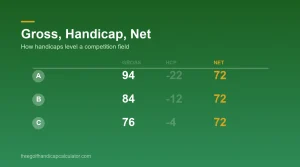
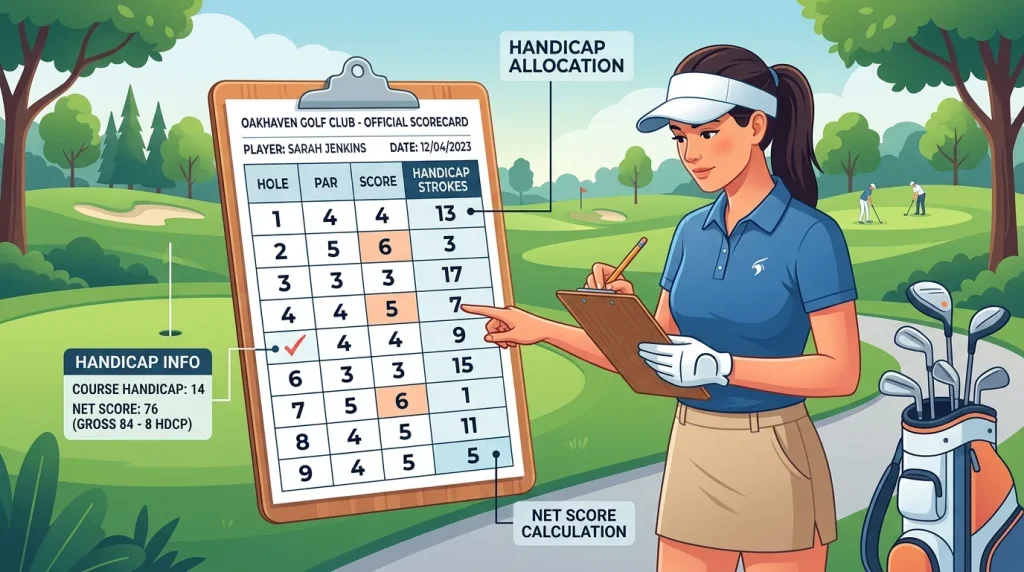
- Net Score: Your gross score minus your Course Handicap for that specific round.
If the handicap system works perfectly, every golfer in a field should theoretically average a Net Score equal to the Course Rating, regardless of whether they are a 2-handicap or a 22-handicap.
Why Your Actual Score Can Be Higher or Lower Than the Benchmark
If you are a 10-handicap but your average score is 88 instead of the benchmark 85.4, do not panic. Several variables can skew your personal average relative to the global data:
- Course Difficulty: If your home course has a very high Course Rating and Slope Rating, your average gross score will be higher than a 10-handicap who plays an easier course, even though your Handicap Indexes are identical.
- Weather and Conditions: Frequent play in high winds, rain, or on highly firm and fast setups inflates average scores.
- Scoring Volatility: Some players are exceptionally erratic. A player who shoots 78, 98, 79, 99 might maintain a 10 handicap (based on the 78 and 79), but their mathematical average will be much higher than a steady player who shoots 85 every single time.
How to Compare Your Score With Other Golfers
To accurately compare your performance against the benchmarks, you must track your data over a meaningful sample size. A single great round or one terrible round does not define your average.
Track Your Own Scores
Use our Golf Score Calculator to log your rounds and determine your true average gross and net scores over time. By tracking this data alongside your golf handicap, you can see if your overall consistency is improving.
If you want to understand why your average score sits where it does, you need to track underlying performance metrics. Use our Putting Average Calculator, Fairways Hit Calculator, and Shot Tracker Calculator to pinpoint exactly where you are losing strokes compared to lower-handicap benchmarks.
Frequently Asked Questions
What is the average golf score for a 10 handicap?
Based on millions of tracked rounds, a 10-handicap golfer averages approximately 85.4 on a typical par-72 course. Their best rounds will be in the high 70s or low 80s, while their bad rounds will approach or exceed 90.
What does a 15 handicap usually shoot?
A 15-handicap typically averages a gross score of about 91.3. On their good days (the rounds that actually count toward their handicap), they will shoot in the mid-80s.
What does a 20 handicap usually shoot?
A 20-handicap golfer averages around 96.8. They will occasionally break 90 on a great day, but will also frequently shoot over 100 on bad days.
What is a good golf score for a beginner?
For a true beginner, simply keeping the ball in play and finishing the round is the goal. Statistically, a score between 105 and 115 is considered a very solid performance for a novice golfer in their first year of playing. To see how beginners stack up, refer to our guide on what is considered a good golf handicap.
Does handicap equal average score?
No. Your Handicap Index is based on the best 8 of your last 20 Score Differentials, not an average of all your scores. Because it ignores your worst 12 rounds, your average gross score will almost always be 3 to 6 strokes higher than your Handicap Index plus par.
Do better golfers always shoot lower scores?
Generally, yes. However, on any given day, a 12-handicap playing exceptionally well can shoot a lower gross score than an 8-handicap having a terrible day. Golf relies on potential and variability, which is why the handicap system exists to enable fair net competition.
Why can two golfers with the same handicap have different average scores?
This happens primarily due to course difficulty and scoring volatility. A player whose home course is extremely difficult will have a higher average gross score than a player at an easy course, even if their Handicap Indexes are exactly the same. Additionally, a highly erratic player will have a higher mathematical average than a very steady player, even if their best 8 rounds (which dictate the handicap) match.