Every official golf handicap depends on an accurate evaluation of the golf course where each score was recorded. Without a standardized way to measure course difficulty, a score of 85 at a flat municipal course and a score of 85 at a punishing championship layout would be treated as identical—which they clearly are not.
The Golf Course Rating System solves this problem. Developed and maintained by the USGA, it is the standardized methodology used worldwide to evaluate the playing difficulty of every rated golf course. It produces the Course Rating, Slope Rating, and Bogey Rating values that make the World Handicap System possible.
This guide explains what the Course Rating System is, how courses are evaluated, what the resulting numbers mean, and why they matter to every golfer who carries a handicap. If you are new to handicapping, start with our foundational guide: What Is a Golf Handicap?
What Is the Golf Course Rating System?
The Golf Course Rating System is a standardized evaluation framework used to assess the playing difficulty of a golf course for two types of players: a scratch golfer and a bogey golfer. By measuring difficulty for both player profiles, the system produces three key outputs:
- Course Rating: The expected score for a scratch golfer (a player with a 0.0 Handicap Index).
- Bogey Rating: The expected score for a bogey golfer (a player with a Handicap Index of approximately 20.0 for men or 24.0 for women).
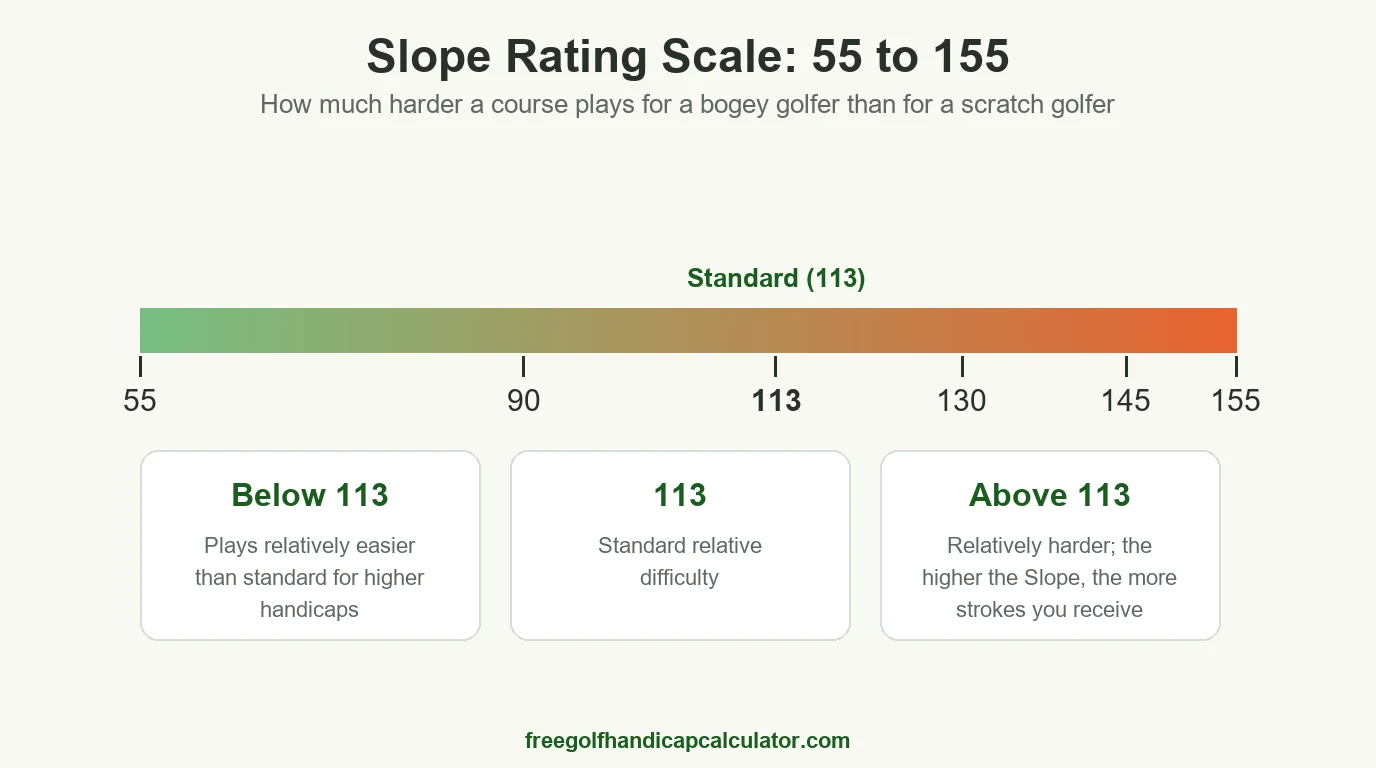
- Slope Rating: A measurement derived from the relationship between the Bogey Rating and the Course Rating, indicating how much harder the course plays for a bogey golfer relative to a scratch golfer. For a detailed explanation of Slope Rating, see our guide: Golf Course Slope Rating Explained.
These three values are assigned to every set of tees on a rated golf course, because the difficulty profile changes depending on which tees are played. They form the foundation that allows the handicap system to compare scores from any course in the world on an equitable basis.
The USGA Course Rating System
The Course Rating System was originally developed by the United States Golf Association (USGA) and has been adopted globally as part of the World Handicap System. The USGA continues to maintain and update the methodology.
The system relies on trained rating teams—volunteers authorized by regional golf associations (known as Authorized Associations or Allied Golf Associations)—who physically evaluate each golf course using a standardized set of criteria. Their evaluation produces quantified difficulty assessments for both the scratch and bogey golfer profiles, ensuring consistency across every rated course.
The USGA Course Rating System is not a casual opinion or a crowdsourced estimate. It is a rigorous, rules-based evaluation that considers the effective playing length of every hole alongside ten specific obstacle factors that influence scoring difficulty.
What Is Course Rating?
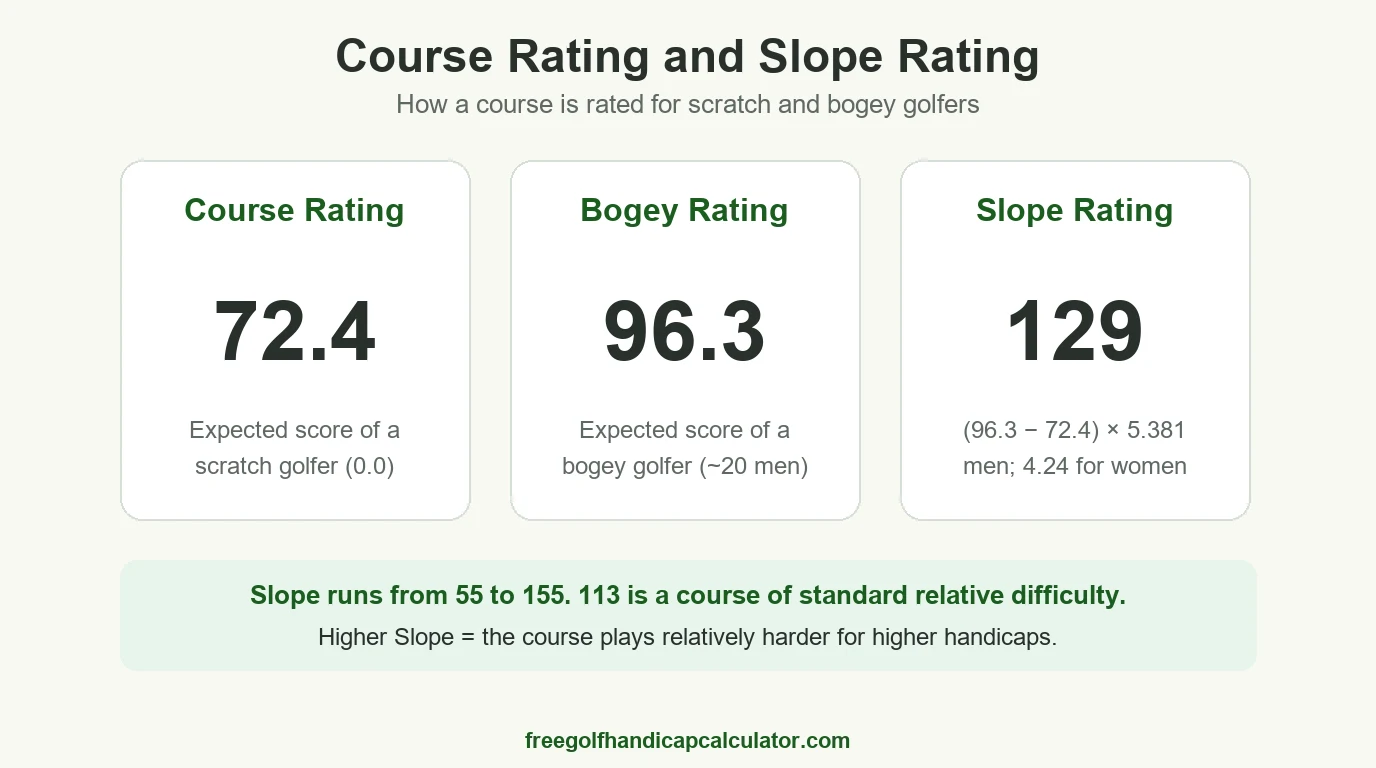
Course Rating is a number, expressed to one decimal place (e.g., 72.4), that represents the expected score a scratch golfer would achieve on the course under normal playing conditions.
A scratch golfer is defined, for rating purposes, as a male player who can hit tee shots an average of 250 yards and can reach a 470-yard hole in two shots, playing to a Course Handicap of zero. Female scratch golfer benchmarks have corresponding distance specifications.
Course Rating Is Not Par
Course Rating and par are related but distinct concepts. Par is a target score set by the course designer based on hole lengths and design intent. Course Rating is an empirically evaluated prediction of how a scratch golfer will actually score, taking into account the full range of difficulty factors the course presents.
As a result, a par-72 course might carry a Course Rating of 70.8, 72.4, or 74.1 depending on its actual difficulty. Two courses with identical par values can have very different Course Ratings because their obstacle profiles, effective playing lengths, and design characteristics differ.
Why Course Rating Matters
Course Rating is one of the primary inputs used by the handicap system to evaluate your performance. When you post a score, the system compares your adjusted gross score against the Course Rating of the tees you played—not against par. This ensures that your Score Differential reflects the true difficulty of the course, not just its nominal par value.
How Are Golf Courses Rated?
This is the core of the USGA Course Rating System. Rating teams evaluate each hole on a course by examining two primary dimensions of difficulty:
1. Effective Playing Length
The first step is to determine the effective playing length of each hole, which can differ significantly from the measured yardage shown on the scorecard. Adjustments are made for:
- Roll: Whether the fairway encourages or limits roll based on firmness and slope.
- Elevation changes: Uphill holes play longer; downhill holes play shorter.
- Doglegs and forced layups: Holes where the tee shot cannot be aimed directly at the green require additional distance calculations.
- Wind: Prevailing wind patterns affect the effective distance a golfer must cover.
- Altitude: Higher altitude reduces air density, causing the ball to travel farther.
2. The Ten Obstacle Factors
Beyond length, rating teams evaluate ten specific obstacle factors on each hole. Each factor is assessed for both the scratch golfer and the bogey golfer, because the same obstacle can affect these two players very differently.
| Obstacle Factor | What It Evaluates |
|---|---|
| Topography | How the terrain affects stance, lie, and shot difficulty. Uneven lies caused by slopes and mounds are evaluated. |
| Fairway | The width and landing area of the fairway relative to the length of the hole. Narrow fairways on long holes increase difficulty. |
| Green Target | The size, shape, firmness, and visibility of the green. Smaller, harder-to-hit greens increase the rating. |
| Recoverability and Rough | How difficult it is to recover after missing the fairway or green. Thick rough, deep grass, and poor lies around the green are evaluated. |
| Bunkers | The number, depth, placement, and difficulty of sand bunkers in landing zones and around greens. |
| Crossing Obstacles | Hazards such as water, ravines, or other forced carries that must be cleared from tee to green. |
| Lateral Obstacles | Hazards running alongside the hole—such as water, dense vegetation, or out-of-bounds—that penalize offline shots. |
| Trees | The density, height, and proximity of trees to the landing areas and the line of play. |
| Green Surface | The speed, contour, and overall difficulty of the putting surface. Heavily contoured, fast greens increase the rating. |
| Psychological / Visual | The mental and visual impact of the hole’s design on shot selection and confidence. Intimidating carries, blind shots, and optical illusions are considered. |
The obstacle values are totaled, weighted, and converted into strokes, which are then combined with the effective playing length to produce the final Course Rating and Bogey Rating for each set of tees. The Slope Rating is then derived from the relationship between these two values.
Course Rating vs Slope Rating
These two ratings are complementary but measure fundamentally different things:
| Aspect | Course Rating | Slope Rating |
|---|---|---|
| What it measures | Expected score for a scratch golfer. | Relative difficulty for a bogey golfer compared to a scratch golfer. |
| Based on | Scratch golfer performance. | The gap between scratch and bogey golfer performance. |
| Typical range | Near par (e.g., 67.0 to 77.0). | 55 to 155 (113 is standard). |
| High value means | Harder for elite players. | Disproportionately harder for higher-handicap players. |
| Directly comparable? | Yes—a higher Course Rating means more difficulty for a scratch golfer. | Not directly—a higher Slope does not mean the course is universally “harder.” |
Both numbers work together in the handicap system. For a deep dive into Slope Rating specifically—including the Bogey Rating, the 55–155 scale, and what 113 means—read our companion guide: Golf Course Slope Rating Explained.
How Course Rating Affects Your Handicap
Course Rating is one of the key course-specific inputs used by the World Handicap System in two places:
- Score Differentials: When you post a score, the system uses the Course Rating (along with the Slope Rating) to calculate your Score Differential—a standardized measure of how you performed relative to the course’s difficulty.
- Course Handicap: When you convert your Handicap Index for a specific course, the Course Rating (minus par) is part of the conversion formula.
The practical takeaway: if you play a course with a Course Rating significantly above par, you will receive a slightly higher Course Handicap than at a course where the Course Rating is at or below par, even if both courses share the same Slope Rating.
For the complete mathematical detail of how these values are used, see our Golf Handicap Calculation Formula Explained guide. To convert your Handicap Index for a specific course, use our Course Handicap Calculator. To calculate a Score Differential, use our Handicap Differential Calculator.
Who Rates Golf Courses?
Course ratings are performed by trained volunteers who serve on rating teams organized by Authorized Associations (also known as Allied Golf Associations in the United States). These are the regional or national golf associations that administer the handicap system under the authority of the USGA or the R&A, depending on jurisdiction.
Rating team members receive formal training in the USGA Course Rating System methodology. They physically walk and evaluate each course, applying the standardized criteria to produce consistent, defensible ratings. The ratings are then reviewed and published by the governing association.
Individual golfers, course owners, or club professionals do not set their own Course Ratings or Slope Ratings. The process is entirely independent to ensure integrity.
How Often Are Golf Courses Re-Rated?
Course conditions and layouts change over time—trees grow or are removed, bunkers are redesigned, tee boxes are moved, and irrigation can alter fairway conditions. To keep ratings accurate, the USGA requires periodic re-evaluation.
Under current USGA guidelines:
- Established courses must be re-rated at least once every 10 years.
- New courses must be re-rated within 5 years of their initial rating, as newly opened courses often mature significantly in their early years.
- Significant changes to a course (such as a major renovation, addition or removal of holes, or substantial changes to hazard placement) may trigger an earlier re-rating.
If a golfer or club believes that a course’s current ratings no longer accurately reflect its playing difficulty, they can request a re-evaluation through their regional Authorized Association.
Why Course Rating and Slope Rating Matter
If every golf course were identical in difficulty, there would be no need for course ratings. A player’s raw score would be all that was needed to compare performance. In reality, courses vary enormously in length, hazard placement, green complexity, and overall challenge.
The Course Rating System exists to make your Handicap Index truly portable. Because every rated course in the world has been evaluated using the same standardized methodology, the World Handicap System can accurately adjust your handicap no matter where you play. A 15.0 Handicap Index means the same thing whether you are playing a links course in Scotland or a desert course in Arizona.
Without these ratings, golfers would have no reliable way to compete fairly across different venues—which is exactly why the USGA developed the system in the first place.
Want the numbers for a course you actually play? Our course rating and slope calculator works out both from the scorecard, and shows what they mean for your Course Handicap.
Frequently Asked Questions
What is Course Rating in golf?
Course Rating is a number (expressed to one decimal place) that represents the expected score a scratch golfer would achieve on a particular course and set of tees under normal playing conditions. It is determined through the USGA Course Rating System.
What is the difference between Course Rating and Slope Rating?
Course Rating measures the expected difficulty for a scratch golfer. Slope Rating measures how much harder the course plays for a bogey golfer relative to a scratch golfer. Both are determined as part of the same evaluation process. For a complete explanation of Slope Rating, see our Slope Rating guide.
Is Course Rating the same as par?
No. Par is a design target set by the course architect. Course Rating is an empirically evaluated prediction of how a scratch golfer will actually score, accounting for all difficulty factors. A par-72 course can have a Course Rating anywhere from the high 60s to the mid-70s depending on its true difficulty.
What does a Course Rating of 72 mean?
A Course Rating of 72.0 means that a scratch golfer is expected to score approximately 72 on that course under normal conditions. If the course is a par 72, then the Course Rating is equal to par—meaning the course plays roughly as expected for an elite player. But many par-72 courses have Course Ratings above or below 72.
Who determines a golf course’s Course Rating?
Course Ratings are determined by trained rating teams authorized by regional golf associations (Authorized Associations) under the governance of the USGA or the R&A. Individual golfers or course operators do not set their own ratings.
How often is a golf course re-rated?
Under current USGA guidelines, established courses must be re-rated at least once every 10 years. New courses must be re-rated within 5 years of their initial rating. Significant course changes may trigger earlier re-evaluation.
Does Course Rating affect my Handicap Index?
Yes. The Course Rating of every course you play is used in the Score Differential formula, which feeds directly into your Handicap Index calculation. For the complete formula, see our Golf Handicap Calculation Formula guide.
Why can two courses with the same par have different Course Ratings?
Because Course Rating accounts for far more than just hole lengths. Two par-72 courses may differ dramatically in their obstacle profiles—bunker placement, green difficulty, rough severity, forced carries, and elevation changes all influence the Course Rating independently of par.
What is Bogey Rating?
Bogey Rating is the expected score for a bogey golfer (a male player with a Handicap Index of approximately 20.0, or a female player with approximately 24.0). While it does not appear on most scorecards, it is a critical behind-the-scenes value used to calculate the Slope Rating. For more detail, see the Bogey Rating section in our Slope Rating guide.