
Putting Average Calculator
Calculate your putting statistics including putts per round, putts per GIR, one-putt and three-putt percentages with PGA Tour benchmark comparisons.
Enter Your Round Data
3 roundsEnter the total putts and greens in regulation (GIR) for each round. Add more rounds for a more accurate average.
How It Works
Understand and improve your putting statistics
Enter Round Data
For each round of golf, enter the total number of putts you took and how many greens you hit in regulation (GIR). Add multiple rounds for more accurate averages.
View Your Stats
The calculator computes your average putts per round, putts per GIR, and estimated one-putt and three-putt percentages. The performance gauge shows where you rank.
Compare to Benchmarks
See how your putting stats compare to amateur averages (15-20 handicap) and PGA Tour professionals. This helps identify specific areas to improve.
Understanding Putting Statistics
Average Putts Per Round is the most commonly tracked putting statistic. PGA Tour professionals average approximately 29 putts per round, while the average amateur (15-20 handicap) averages around 33-34 putts. The key insight is that better putters don't necessarily have fewer putts overall — they hit more greens in regulation, meaning they putt from closer distances.
Putts Per GIR is considered the gold standard for measuring pure putting skill, as it eliminates the advantage of chipping close to the hole. PGA Tour pros average about 1.54 putts per GIR, while amateurs typically average 1.80-1.90. This stat truly isolates your putting ability from the rest of your game.
One-Putt Percentage measures how often you hole out with a single putt. This is heavily influenced by your proximity to the hole. PGA Tour pros one-putt about 30% of the time, while amateurs are around 15-20%. Improving your approach shots to leave shorter first putts is the fastest way to improve this statistic.
Three-Putt Percentage tracks how often you take three or more putts on a single green. This is the stat that has the biggest impact on your score. PGA Tour pros three-putt only about 4% of the time, while amateurs three-putt 8-12% of greens. Eliminating three-putts is often the quickest way to lower your scores.
Tracking your performance on the green is one of the most effective and direct ways to lower your overall golf scores. A dedicated putting average calculator helps you deeply understand your putting efficiency, isolating your short game from your ball striking, and identifying key areas where you can easily save strokes. Whether you are a beginner aiming to break 100 for the first time or a seasoned player trying to reach a scratch handicap, accurately knowing your putting statistics is absolutely crucial for targeted improvement.
What Is a Putting Average Calculator?
A putting average calculator is a specialized analytical tool that evaluates your performance on the green across multiple rounds of golf. It takes your raw scorecard data—specifically total putts and greens in regulation—and converts them into highly meaningful metrics such as average putts per round and putts per hole. By generating these advanced metrics and comparing these figures against standard amateur and professional benchmarks, you can clearly see exactly how your putting stacks up and where your biggest weaknesses lie.
How Does a Putting Average Calculator Work?
Using the calculator is an incredibly simple process that is designed to accommodate both partial and full rounds of golf. The tool dynamically adjusts its mathematical calculations based on the actual number of holes you played, ensuring your averages are never artificially inflated by an incomplete round.
Enter Your Holes Played
For each round you log, you must first select the correct number of holes played. The tool natively supports standard 18-hole rounds as well as shorter 9-hole rounds. Selecting the exact number of holes is vital because the putting average calculator uses the total actual holes played across all your entries to determine your true, accurate per-hole average.
Enter Total Putts
Next, carefully input the total number of putts you took during that specific round. Be sure to honestly count every single stroke taken with your putter while you are on the putting surface, including tap-ins and mishits.
Enter Greens in Regulation
Finally, enter your total Greens in Regulation (GIR). You hit a green in regulation when your ball successfully reaches the putting surface in two strokes fewer than the hole’s par (for example, reaching a par-4 green in two strokes, or a par-5 in three). Keep in mind that your GIR cannot possibly exceed the total number of holes played in that round.
How Is Putting Average Calculated?
It is incredibly important to understand the fundamental difference between calculating Average Putts Per Round and Putts Per Hole when analyzing your golf putting statistics.
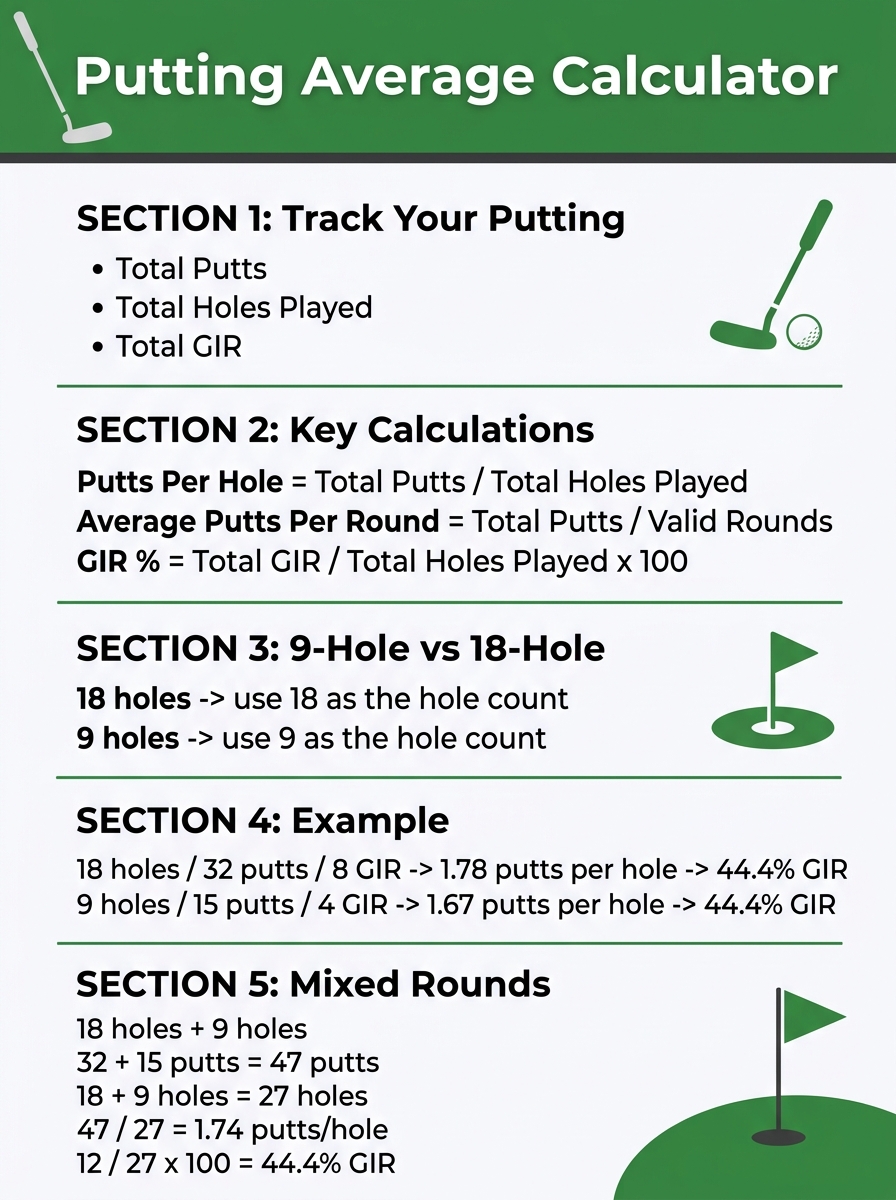
- Average Putts Per Round = Total Putts ÷ Number of Valid Rounds. This simple calculation gives you a general, high-level overview of your total stroke count on the greens per golfing session.
- Putts Per Hole = Total Putts ÷ Total Holes Played. This is a much more precise and useful metric that remains mathematically accurate regardless of whether you played a mix of 9-hole or 18-hole rounds.
- GIR Percentage = Total GIR ÷ Total Holes Played × 100. This percentage tells you exactly how frequently you are giving yourself a legitimate birdie or par opportunity by hitting the green in the expected number of shots.
What Is a Good Number of Putts Per Hole?
Evaluating your own golf putting statistics against established historical benchmarks can effectively guide your practice sessions. PGA Tour professionals are incredibly efficient, averaging around 1.61 putts per hole and approximately 29 total putts per round. Conversely, a typical amateur golfer (playing off a 15-20 handicap) averages about 1.86 putts per hole and 33.5 putts per 18-hole round. Tracking your progress toward these amateur benchmarks is an excellent short-term goal.
Putting Average Calculator Example
To clearly demonstrate the underlying math, here is a standard 18-hole numerical example. Suppose you play a full 18 holes, take exactly 32 putts, and manage to hit 8 Greens in Regulation.
- Average Putts/Round = 32.0
- Putts/Hole = 32 ÷ 18 = 1.78
- GIR = 8 ÷ 18 × 100 = 44.4%
If you only have time for a quick 9-hole round after work and you record 15 putts alongside 4 GIR, the calculation dynamically adjusts accordingly:
- Putts/Hole = 15 ÷ 9 = 1.67
- GIR = 4 ÷ 9 × 100 = 44.4%
A highly useful key feature of this tool is its ability to seamlessly handle mixed rounds. For instance, if you combine the two diverse rounds above (Round 1: 18 holes / 32 putts / 8 GIR; Round 2: 9 holes / 15 putts / 4 GIR), the calculator merges them perfectly:
- Total Putts = 47
- Total Holes = 27
- Average Putts/Round = 23.5
- Putts/Hole = 1.74
- GIR = 44.4%
Why Track Putts Per Hole?
Tracking your putting consistency meticulously helps isolate your short game performance from the rest of your full swing. If your Golf Score Calculator results are consistently higher than you expected, your putting average might quickly reveal whether the primary issue lies struggling on the greens or missing in the fairways. High putts per hole usually indicate a strong need for better long distance control and fewer costly three-putts. Furthermore, improving your iron approach shots—which you can measure with tools like the Club Distance Calculator or a standard Golf Distance Calculator—can leave you significantly closer to the hole, naturally lowering your putting average without changing your actual putting stroke.
Related Tools
Explore more golf calculators to improve your game