
Sand Save Calculator
Track your sand save percentage across multiple rounds. See how you compare to PGA Tour and amateur averages.
Enter Your Rounds
| Round | Date | Sand Attempts | Sand Saves | Actions |
|---|---|---|---|---|
| 1 |
Sand Save Calculation Guide
Tips for Improving Sand Play
Open the Clubface
Open your sand wedge face at address. This adds loft and helps the ball pop up quickly out of the bunker.
Hit Behind the Ball
Aim to strike the sand 1-2 inches behind the ball. The sand cushion lifts the ball out. Never make ball-first contact.
Use a Steep Swing
Swing steeply (more vertical) rather than sweeping. This helps you enter the sand at the right angle.
Commit to the Shot
Don’t decelerate. Swing through the sand with full commitment and follow through completely.
Practice Different Distances
Vary the length of your swing for different distances. A shorter swing with an open face for short shots, fuller swing for longer ones.
Weight Forward
Keep 60-70% of your weight on your front foot throughout the swing. This promotes a descending strike into the sand.
How It Works
What is a Sand Save?
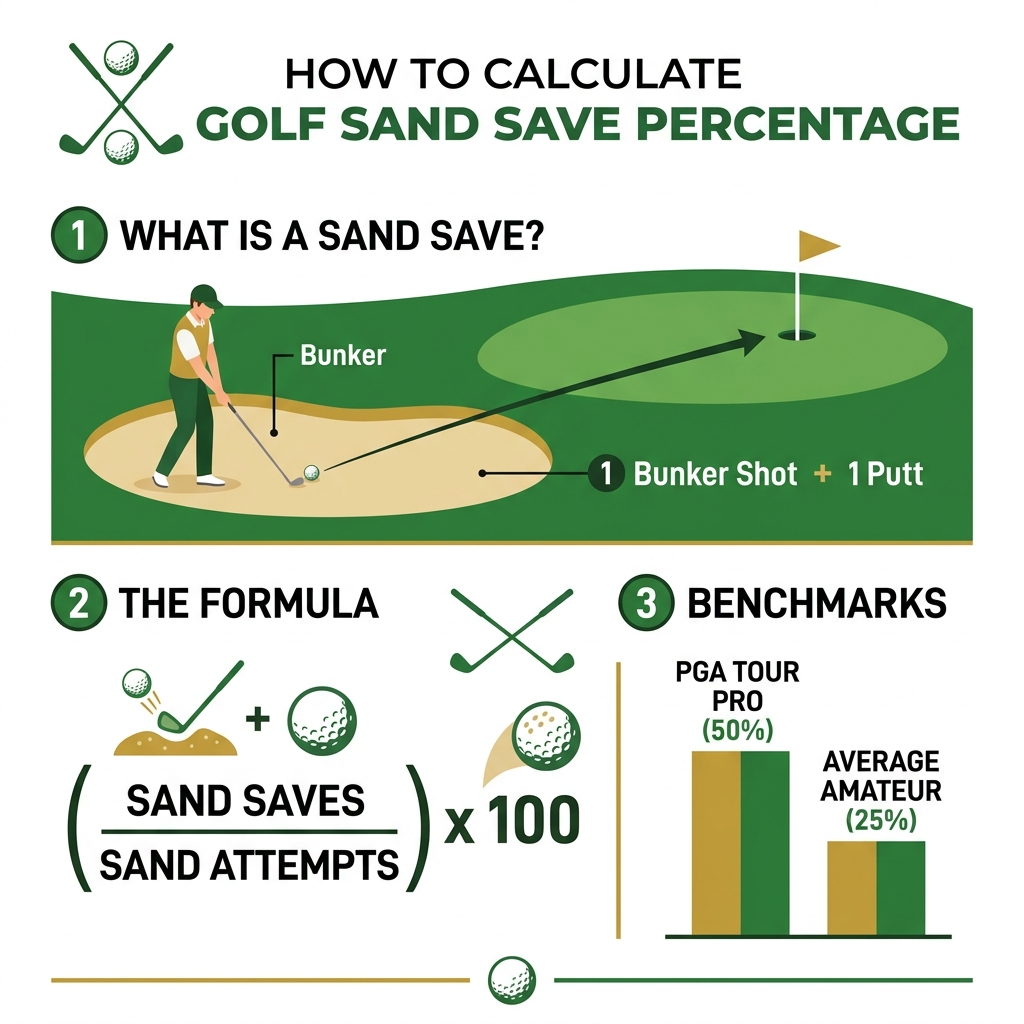
A sand save is getting up and down in 2 shots or less from a greenside bunker. This includes the bunker shot plus the putt.
Track Your Rounds
Enter your sand shot attempts and successful saves for each round. Add as many rounds as you want.
Compare & Improve
See how your sand save % compares to PGA Tour pros (~50%) and average amateurs (~25%), then work on improvement.
What Is a Sand Save?
A sand save occurs when a golfer hits their ball into a greenside bunker (sand trap) and successfully gets the ball up and down in two strokes or less to complete the hole. This means taking one shot to get out of the bunker and onto the green, followed by exactly one putt to hole out. Sand saves are a critical indicator of a golfer’s short game proficiency and ability to scramble when missing the green in regulation.
How to Calculate Sand Save Percentage?
Calculating your sand save percentage is straightforward. The math involves taking the number of successful sand saves and dividing it by the total number of greenside bunker attempts, then multiplying by 100 to get a percentage.
- Sand Attempts: The total number of times you hit into a greenside bunker.
- Sand Saves: The number of times you successfully got up and down in two strokes or less from those bunkers.
- Formula: (Sand Saves ÷ Sand Attempts) × 100 = Sand Save Percentage
For example, if you hit into 10 greenside bunkers over several rounds and successfully save par (or better) from 4 of them, your sand save percentage would be 40%.
PGA Tour vs Amateur Sand Save Averages
The Sand Save Calculator allows you to compare your performance against established benchmarks in the golf world:
- PGA Tour Average: Professional golfers on the PGA Tour typically average around a 50% sand save rate. This means they get up and down from greenside bunkers half the time.
- Amateur Average: The average amateur golfer typically hovers around a 25% sand save rate.
By comparing your percentage to these averages, you can quickly identify whether your bunker play is a strength you can rely on or a weakness that requires dedicated practice.
For tracking other important short-game metrics alongside your sand saves, try the Putting Average Calculator or use the Scramble Calculator to track all up-and-down attempts, not just those from the sand.