Every rated golf course in the world carries a Slope Rating. If you have ever looked at a scorecard and wondered what the number next to “Slope” actually means, or why your Course Handicap changes dramatically when you move from your home course to a championship layout, the answer lies in understanding this single metric.
Slope Rating is one of two official measurements—alongside Course Rating—that the USGA Course Rating System assigns to every set of tees on a golf course. Together, these numbers make it possible for the World Handicap System to ensure that golfers of all abilities can compete fairly, regardless of where they play.
This guide explains what Slope Rating is, how it is determined, what the numbers mean in practice, and how it relates to your handicap. If you are new to the concept of handicapping altogether, start with our foundational guide: What Is a Golf Handicap?
What Is Slope Rating in Golf?
Slope Rating is an official numerical measurement, defined by the USGA, that indicates the relative difficulty of a golf course for a bogey golfer compared to a scratch golfer.
In simple terms, it answers the question: “How much harder does this course play for higher-handicap golfers relative to how it plays for elite golfers?”
A course where the difficulty gap between a scratch golfer and a bogey golfer is very large will have a high Slope Rating. A course where both types of players face a similar level of challenge will have a lower Slope Rating.
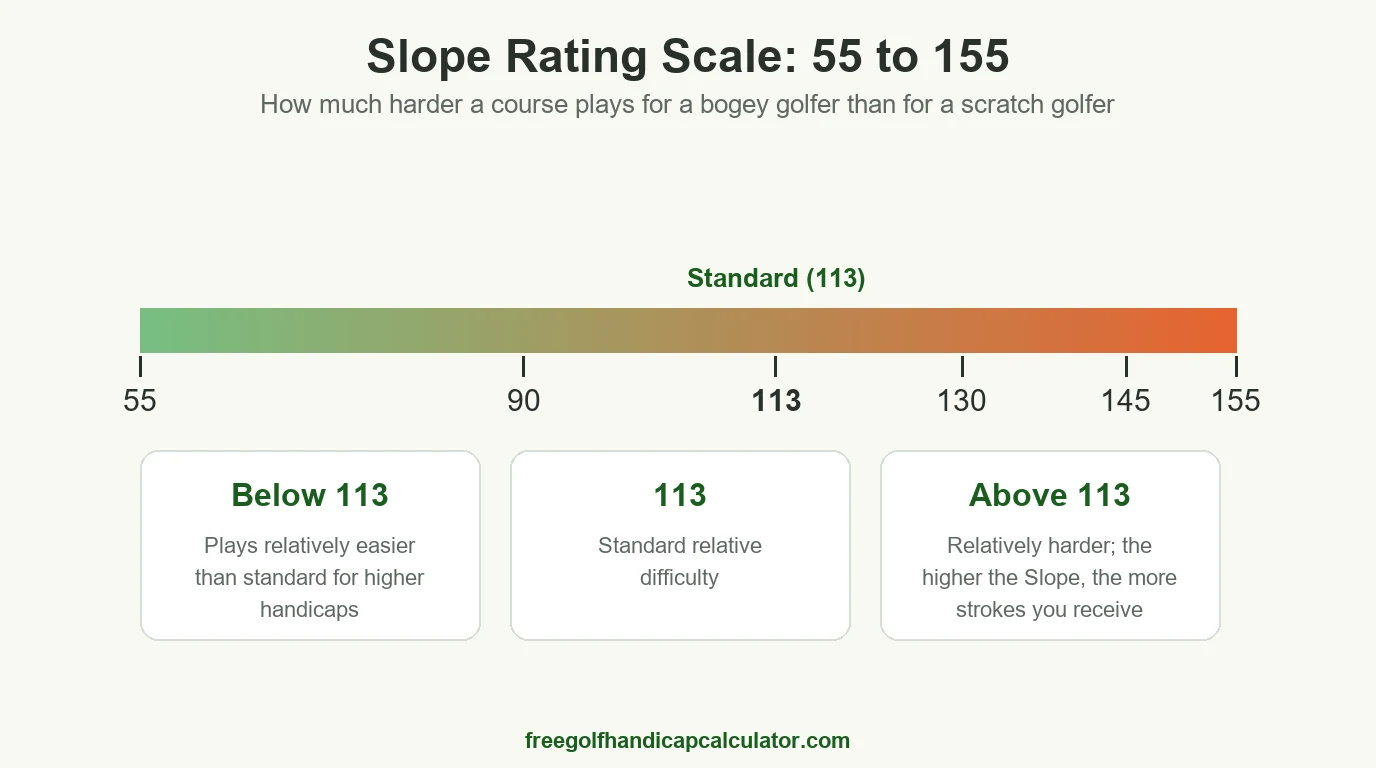
Slope Ratings range from 55 to 155, with 113 defined as the rating for a course of standard relative difficulty. Every set of tees on every rated golf course receives its own Slope Rating, because the difficulty relationship changes depending on which tees you play.
How Slope Rating Is Determined
Slope Rating is not a subjective opinion. It is derived through the USGA Course Rating System—a rigorous, standardized evaluation process carried out by trained rating teams authorized by regional golf associations.
The process works as follows:
- Evaluate for the scratch golfer: The rating team assesses the course to determine the expected score for a scratch golfer (a player with a Handicap Index of 0.0). This produces the Course Rating.
- Evaluate for the bogey golfer: The same team assesses the course to determine the expected score for a bogey golfer (a player with a Handicap Index of approximately 20.0 for men or 24.0 for women). This produces the Bogey Rating.
- Calculate the difference: The Slope Rating is derived from the mathematical relationship between the Bogey Rating and the Course Rating. The greater the gap between these two expected scores, the higher the Slope Rating—meaning the course disproportionately penalizes higher-handicap players.
Both evaluations consider the effective playing length of each hole (adjusted for elevation, wind, roll, doglegs, and altitude) and ten specific obstacle factors that affect how a scratch golfer and a bogey golfer experience the course differently. For a complete explanation of the rating methodology, see our guide to the Golf Course Rating System.
What Is a Bogey Rating?
The Bogey Rating is the USGA’s measurement of a golf course’s playing difficulty for a bogey golfer under normal course and weather conditions. While Course Rating and Slope Rating appear on most scorecards, the Bogey Rating is a behind-the-scenes value that is essential to calculating the Slope Rating.
The Bogey Golfer Defined
For course-rating purposes, the USGA defines the bogey golfer with specific benchmarks:
- Male bogey golfer: A player with a Handicap Index of approximately 20.0 who can hit tee shots an average of 200 yards and can reach a 370-yard hole in two shots.
- Female bogey golfer: A player with a Handicap Index of approximately 24.0, with corresponding distance benchmarks.
These are not arbitrary numbers. They represent statistically modeled player profiles that the USGA uses to ensure consistency in course evaluations across every rated golf course.
Why Bogey Rating Matters
Without the Bogey Rating, there would be no way to measure how much harder a course plays for the typical recreational golfer compared to an elite player. Some courses—particularly those with forced carries over water, heavily penalizing rough, or severe elevation changes—become exponentially harder for higher-handicap players. Other courses are more “democratic,” challenging all skill levels in roughly equal proportion.
The Bogey Rating captures this difference. When it is compared against the Course Rating, the resulting Slope Rating tells the handicap system exactly how to adjust a player’s handicap for that specific course and set of tees.
For comparison, the scratch golfer is defined as a male player who can hit tee shots an average of 250 yards and can reach a 470-yard hole in two shots, playing to a Course Handicap of zero.
The Slope Rating Scale: 55 to 155
Slope Ratings exist on a fixed scale defined by the USGA:
| Slope Rating | Interpretation |
|---|---|
| 55 | Minimum possible. The course is very easy for higher-handicap players relative to scratch golfers. |
| Below 113 | The difficulty gap between scratch and bogey golfers is smaller than average. |
| 113 | Standard relative difficulty. This is the defined neutral baseline. |
| Above 113 | The difficulty gap between scratch and bogey golfers is larger than average. |
| 155 | Maximum possible. The course is extremely challenging for higher-handicap players relative to scratch golfers. |
Most golf courses you will encounter have Slope Ratings somewhere between 100 and 140. Courses at the extreme ends of the scale are rare.
A critical point: a high Slope Rating does not necessarily mean the course is “hard” in an absolute sense. It means the course is relatively harder for higher-handicap players than it is for scratch golfers. A course can have a modest Course Rating (indicating it is not especially difficult for a scratch golfer) but still carry a high Slope Rating if its hazards and design features disproportionately affect less-skilled players.
What Does a Slope Rating of 113 Mean?
The number 113 is defined by the USGA as the Slope Rating of a golf course of standard relative difficulty. It serves as the universal baseline—the anchor point—for the entire handicap system.
At a course with a Slope Rating of 113:
- The difficulty gap between a scratch golfer and a bogey golfer is considered “average” or “standard.”
- A golfer’s Course Handicap will be very close to their Handicap Index (assuming the Course Rating is near par).
The number 113 also appears in both the Score Differential formula and the Course Handicap formula, where it acts as the divisor or multiplier that scales a player’s performance against the standard baseline. For a full explanation of how 113 functions mathematically in these formulas, see our Golf Handicap Calculation Formula Explained guide.
How Slope Rating Affects Your Handicap
Slope Rating has a direct, practical impact on two key elements of your handicap:
Your Course Handicap
When you arrive at a golf course, your portable Handicap Index must be converted into a Course Handicap for the specific set of tees you are playing. The Slope Rating of those tees is a primary input in this conversion.
- If the Slope Rating is higher than 113, your Course Handicap will be higher than your Handicap Index—you receive more strokes because the course disproportionately challenges higher-handicap players.
- If the Slope Rating is lower than 113, your Course Handicap will be lower than your Handicap Index—you receive fewer strokes because the difficulty gap is smaller.
You can convert your Handicap Index instantly using our Course Handicap Calculator.
Your Score Differentials
Every time you post a score, the system calculates a Score Differential that accounts for the Slope Rating of the course you played. This ensures that a score posted on a high-Slope course is fairly compared against a score posted on a low-Slope course.
To calculate a Score Differential, use our Handicap Differential Calculator. To understand how your differentials combine to form your Handicap Index, use our Handicap Index Calculator.
Slope Rating vs Course Rating
Slope Rating and Course Rating are complementary but fundamentally different measurements. Understanding the distinction is essential.
| Aspect | Course Rating | Slope Rating |
|---|---|---|
| What it measures | The expected score for a scratch golfer (0.0 Handicap Index). | The relative difficulty for a bogey golfer compared to a scratch golfer. |
| Who it’s based on | A scratch golfer. | The relationship between a scratch golfer and a bogey golfer. |
| Typical range | Usually close to par (e.g., 67.0 to 77.0). | 55 to 155 (113 is standard). |
| What a high value means | The course is difficult for elite players. | The course is disproportionately difficult for higher-handicap players. |
| Directly comparable? | Yes—a 72.5 Course Rating is harder for a scratch golfer than a 70.1. | Not directly—a higher Slope does not mean the course is universally “harder.” |
Both values are assigned by trained rating teams as part of the USGA Course Rating System. A course’s full difficulty profile requires both numbers working together. To understand the complete rating framework, see our guide: Golf Course Rating System Explained.
Common Misconceptions About Slope Rating
Because Slope Rating involves concepts that are unfamiliar to most recreational golfers, several persistent misconceptions exist:
- Misconception: A higher Slope Rating means a “better” or more prestigious golf course.
Reality: Slope Rating measures relative difficulty for higher-handicap players, not the quality or prestige of a course. A well-designed municipal course can have a higher Slope Rating than a famous championship venue if its hazards disproportionately affect less-skilled players. - Misconception: Slope Rating and Course Rating are the same thing.
Reality: They measure entirely different aspects of difficulty. Course Rating evaluates difficulty for a scratch golfer. Slope Rating evaluates the gap in difficulty between a scratch golfer and a bogey golfer. A course can have a low Course Rating and a high Slope Rating, or vice versa. - Misconception: 113 means a course is of “average” overall difficulty.
Reality: 113 represents a course of standard relative difficulty—meaning the difficulty gap between a scratch and bogey golfer is average. It says nothing about the absolute difficulty of the course for any specific player. - Misconception: Slope Rating is itself your handicap or the number of strokes you receive.
Reality: Slope Rating is a property of the golf course, not of the player. It is one of the inputs used to calculate your Course Handicap, but it is not a handicap in itself. - Misconception: Slope Rating replaces Course Rating.
Reality: Both are required. The handicap system uses Course Rating, Slope Rating, and par together to convert your Handicap Index into a Course Handicap and to calculate Score Differentials. Neither can function without the other.
Want the numbers for a course you actually play? Our course rating and slope calculator works out both from the scorecard, and shows what they mean for your Course Handicap.
Frequently Asked Questions
What is a good Slope Rating for a golf course?
There is no universally “good” Slope Rating. Most courses fall between 100 and 140. A course with a Slope Rating around 113 offers a standard relative challenge. Courses above 130 tend to be significantly more challenging for higher-handicap players, while courses below 100 tend to present a more uniform challenge across skill levels.
Is a Slope Rating of 113 difficult?
A Slope Rating of 113 indicates standard relative difficulty—it does not tell you whether the course is easy or hard in absolute terms. A course with a 113 Slope but a Course Rating of 75.0 would still be challenging for most golfers. The Slope tells you how the challenge scales between scratch and bogey players.
What does a Slope Rating of 130 mean?
A Slope Rating of 130 means the course is significantly more challenging for a bogey golfer relative to a scratch golfer than a course of standard difficulty. When you convert your Handicap Index to a Course Handicap at this course, you will receive more strokes than you would at a course with a lower Slope. Use our Course Handicap Calculator to see the exact adjustment.
What does a Slope Rating of 90 mean?
A Slope Rating of 90 means the difficulty gap between a scratch golfer and a bogey golfer is smaller than standard. Higher-handicap players will receive fewer additional strokes than they would at a course with a higher Slope. This does not mean the course is easy—it means the challenge is more evenly distributed across skill levels.
Is Slope Rating the same as Course Rating?
No. Course Rating measures the expected score for a scratch golfer. Slope Rating measures how much harder the course plays for a bogey golfer relative to a scratch golfer. Both are distinct components of the USGA Course Rating System.
Does Slope Rating affect my Handicap Index?
Yes. The Slope Rating of the course you played is used in the Score Differential formula, which directly feeds into your Handicap Index calculation. Playing on courses with different Slope Ratings will produce different Score Differentials even if your gross score is identical. For details, see our Golf Handicap Calculation Formula guide.
Why is 113 used as the Slope Rating baseline?
The USGA defines 113 as the Slope Rating of a golf course of standard relative difficulty. It serves as the neutral reference point in the handicap formulas, allowing scores from courses of varying difficulty to be compared on an equal basis. For the mathematical detail, see our formula guide.
Who determines a golf course’s Slope Rating?
Slope Ratings are determined by trained rating teams authorized by regional golf associations (known as Authorized Associations or Allied Golf Associations) under the governance of the USGA. These teams follow the standardized USGA Course Rating System methodology.