To calculate your golf handicap under the World Handicap System (WHS), you need scores from at least 54 holes, for example three 18-hole rounds. For each round, you calculate a score differential using the formula: (Adjusted Gross Score − Course Rating) × 113 ÷ Slope Rating. Your Handicap Index is then the average of your best 8 differentials from your most recent 20 rounds. The entire process is governed jointly by the USGA and R&A, and under WHS rules your handicap updates daily after every posted score.
Understanding exactly how this formula works — and why each component exists — gives you the ability to track your improvement with precision, verify that your handicap accurately reflects your game, and make smarter decisions about practice and course management. This guide walks through every step of the handicap calculation process, from raw score to final Handicap Index, with worked examples using real numbers.
Golf Handicap Calculation Formula Explained

The Handicap Differential Formula
The foundation of the entire handicap system is the score differential. Every time you complete an 18-hole round and post your score, the WHS converts that raw score into a standardised number that accounts for the difficulty of the course you played. This standardisation is what makes it possible to compare rounds played on different courses with different levels of difficulty.
The handicap differential formula is:
Score Differential = (Adjusted Gross Score − Course Rating) × 113 ÷ Slope Rating
Each variable in this formula serves a specific purpose:
- Adjusted Gross Score — Your total score for the round after applying the maximum hole score limits defined by the WHS (net double bogey adjustment, explained later in this guide).
- Course Rating — A number, usually between 67 and 77, that represents the expected score of a scratch golfer (0.0 Handicap Index) on that course from a specific set of tees. Course Ratings are established by authorised rating teams and published for every rated course.
- Slope Rating — A number between 55 and 155 that measures the relative difficulty of a course for a bogey golfer compared to a scratch golfer. The standard Slope Rating is 113, which represents a course of average relative difficulty.
- 113 — The standard (neutral) Slope Rating value. Dividing by the actual Slope Rating and multiplying by 113 normalises every differential to this baseline, so a differential of 10.0 means the same thing regardless of whether you played a course with a Slope of 95 or 145.
The number 113 is not arbitrary — it was established by the USGA as the standard Slope Rating representing the average difference in difficulty between a scratch golfer and a bogey golfer across thousands of rated courses. Every differential you calculate is normalised against this baseline, which is what allows the system to compare scores from courses with vastly different difficulty levels on a single, consistent scale.
Worked Example: A golfer shoots an adjusted gross score of 88 on a course with a Course Rating of 72.2 and a Slope Rating of 128. The calculation is: (88 − 72.2) × 113 ÷ 128 = 15.8 × 113 ÷ 128 = 1785.4 ÷ 128 = 13.9. This golfer’s score differential for that round is 13.9.
Step-by-Step Handicap Calculation
Calculating your Handicap Index from scratch involves a clear sequence of steps. Whether you are computing it manually to understand the system or simply want to verify the number your club or app has given you, the process follows this exact order.
- Play and post your scores. Complete your round under the Rules of Golf on a course with a valid Course Rating and Slope Rating. Post your adjusted gross score through your club, golf association app, or an authorised handicapping service such as GHIN.
- Calculate each score differential. For every posted round, apply the differential formula: (Adjusted Gross Score − Course Rating) × 113 ÷ Slope Rating. Record each differential to one decimal place.
- Identify how many differentials to use. The WHS uses a sliding scale based on how many rounds you have on file. With 3 rounds, you use only the lowest 1. With 6 rounds, you use the lowest 2. With 20 or more, you use the lowest 8. The full table is provided in the next section.
- Average the selected differentials. Add together the differentials you are using and divide by the count. For example, if your best 8 differentials sum to 96.0, the average is 96.0 ÷ 8 = 12.0.
- Apply any adjustment. With only 3 to 6 scores the WHS subtracts a fixed amount (2.0 with 3 scores, 1.0 with 4 or 6); with 7 or more scores there is no adjustment. With 20 scores the average itself is your Handicap Index: 12.0 in this example.
- Round to one decimal place. The result is rounded to the nearest tenth: 11.54 becomes 11.5 and 11.56 becomes 11.6.
You can verify your own calculations instantly using our free handicap calculator, which performs the entire process from posted scores to final Handicap Index.
Converting Differential to Handicap Index
The conversion from individual differentials to a Handicap Index involves selecting and averaging, plus an adjustment when you have only a few scores. The key concept is that the WHS measures your potential ability — not your average performance. That is why the system uses your best 8 differentials out of 20, roughly your best 40% of recent rounds, rather than all of them.
If you post a round that produces an exceptionally low differential — one that is at least 7.0 strokes below your current Handicap Index — the WHS applies an Exceptional Score Reduction (ESR). This triggers an immediate downward adjustment to your index, which may be as much as a 2.0 reduction. This safeguard prevents a single extraordinary round from appearing as a statistical anomaly; the system recognises genuine breakthroughs quickly.
Understanding Handicap Differentials
A handicap differential is the standardised measure of a single round’s performance relative to the course difficulty. It strips away the influence of which course you played and how hard it was, leaving only a number that reflects how well you performed against the expected difficulty. Two differentials of 14.0 represent equivalent performances — even if one was shot at a municipal course with a Slope of 110 and the other at a championship course with a Slope of 145.
You can compute individual differentials quickly using the handicap differential calculator, which returns your differential instantly after you enter your score, Course Rating, and Slope Rating.
Worked Example: A beginner posts three scores on different courses:
| Round | Adjusted Score | Course Rating | Slope Rating | Differential |
|---|---|---|---|---|
| 1 | 102 | 71.5 | 125 | 27.6 |
| 2 | 98 | 70.8 | 130 | 23.6 |
| 3 | 105 | 72.0 | 118 | 31.6 |
With only 3 rounds on file, the system uses the best 1 differential. The lowest is 23.6 (Round 2). After applying the sliding scale adjustment for 3 rounds (which subtracts 2.0), the initial Handicap Index would be 21.6.
The Playing Condition Calculation (PCC) can further adjust differentials on days when course conditions — such as strong wind, rain, or unusually firm greens — cause scores across the field to deviate significantly from the expected norm. On such days, the PCC applies a correction factor between −1.0 and +3.0 to every differential posted at that course, ensuring that your handicap is not unfairly inflated or deflated by conditions beyond your control.
How Many Scores You Need
Score Requirements by Number of Rounds
A common question from golfers new to the system is how many rounds are required before the handicap calculation reaches full accuracy. Under the WHS, you need a minimum of 54 holes — equivalent to three 18-hole rounds or six 9-hole rounds — to establish your initial Handicap Index. However, the calculation only reaches its full precision once you have 20 or more rounds on file.
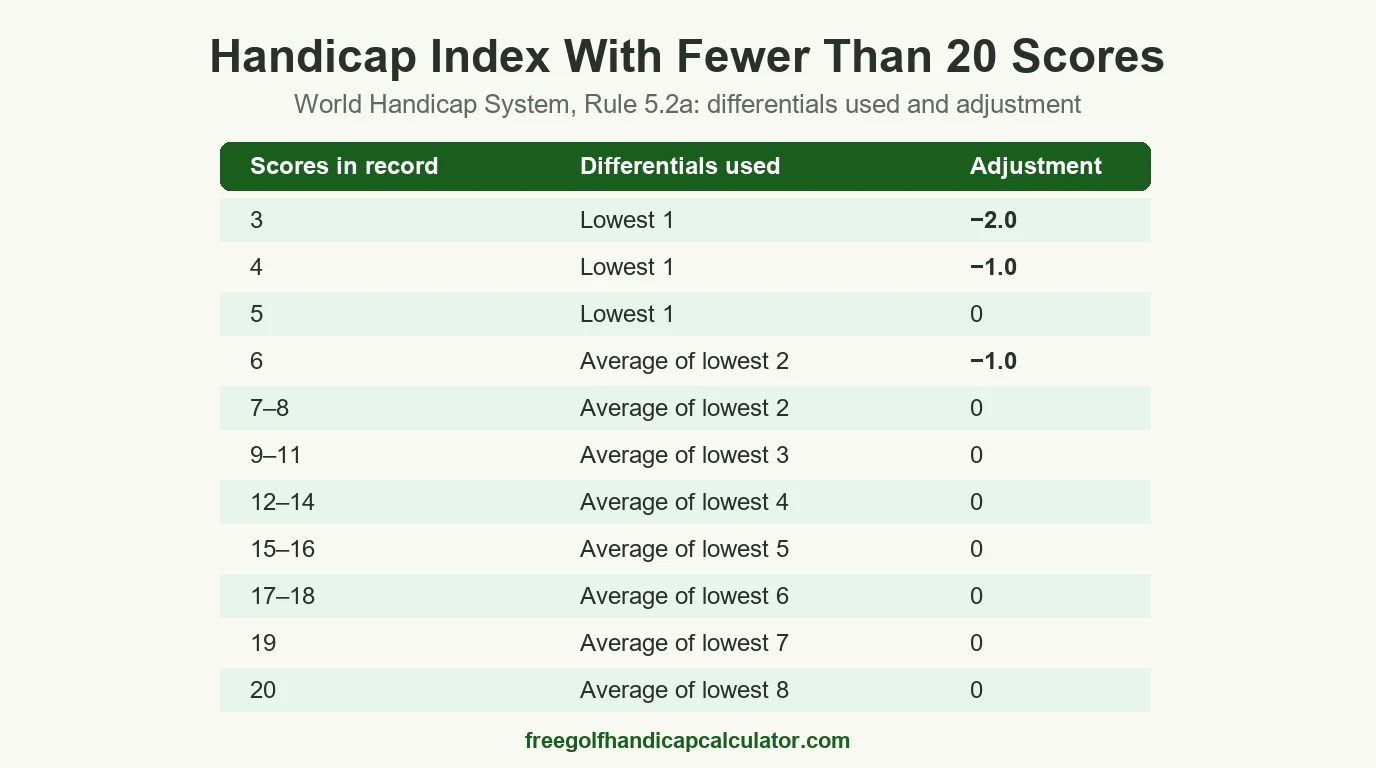
The sliding scale below shows exactly how many differentials are used based on your total number of available scores:
| Scores Available | Differentials Used | Adjustment |
|---|---|---|
| 3 | Lowest 1 | −2.0 |
| 4 | Lowest 1 | −1.0 |
| 5 | Lowest 1 | 0 |
| 6 | Lowest 2 | −1.0 |
| 7–8 | Lowest 2 | 0 |
| 9–11 | Lowest 3 | 0 |
| 12–14 | Lowest 4 | 0 |
| 15–16 | Lowest 5 | 0 |
| 17–18 | Lowest 6 | 0 |
| 19 | Lowest 7 | 0 |
| 20+ | Lowest 8 | 0 |
The adjustment column reflects the additional reduction applied to the average of your selected differentials when you have very few scores. This compensates for the statistical unreliability of a small sample — with only 3 rounds, the system cannot be confident that your single best differential truly represents your potential, so it subtracts 2.0 strokes as a conservative correction.
Most golfers who play regularly — once or twice per week — will accumulate 20 scores within about 10 to 20 weeks. At that point, the handicap reaches its designed accuracy level. If you want to convert your Handicap Index into the number of strokes you receive on a specific course, our course handicap calculator handles that conversion automatically.
The Best 8 of 20 System

Once you have 20 or more scores on file, the WHS uses a fixed rule: take your best 8 score differentials from the most recent 20 rounds, and average them. This is often called the “best 8 of 20” system, and it is central to how the modern Handicap Index works.
The rationale behind using 8 out of 20 — rather than all 20 — is deliberate. The WHS is designed to measure your demonstrated potential, not your average performance. On any given round, a golfer might be affected by fatigue, weather, unfamiliarity with a course, or simply a bad day. By selecting only the best 40% of your recent rounds, the system filters out these performance outliers and captures what you are genuinely capable of when you play well.
What Changes Under the World Handicap System
Before the WHS launched in January 2020, different countries used different formulas. The old USGA system used the best 10 of 20 differentials with a 0.96 multiplier. The CONGU system in the UK used a different methodology entirely, based on Competition Scratch Scores rather than individual course ratings. Golf Australia had its own system, as did South Africa, Europe, and other regions.
The WHS unified all six systems into a single global standard. The key changes were:
- Switching from best 10 of 20 (USGA) to best 8 of 20, making the index more reflective of potential ability.
- Introducing the Playing Condition Calculation (PCC) to account for daily course conditions.
- Implementing a universal maximum hole score (net double bogey) to replace the various versions of Equitable Stroke Control used by different systems.
- Allowing both competitive and recreational rounds to count equally toward the handicap.
- Introducing the Exceptional Score Reduction (ESR) for significant breakthrough performances.
- Reducing the minimum rounds required from 5 (under the old USGA system) to 3.
For golfers who track their game closely, the practical difference between the old best-10-of-20 and the new best-8-of-20 is that the WHS uses fewer, better rounds (8 of 20 instead of 10 of 20) and no longer applies the 0.96 multiplier. How much an individual index changed depended on the spread of that golfer’s differentials.
Adjusted Gross Score Explained
Net Double Bogey vs Equitable Stroke Control
Before you can calculate a score differential, you must first determine your adjusted gross score. This is your actual gross score with a cap applied to each individual hole to prevent one or two disastrous holes from distorting your differential. Under the WHS, the maximum score you can record on any single hole is a net double bogey — which equals the par of the hole, plus two strokes, plus any handicap strokes you receive on that hole.
For example, on a par-4 hole where your Course Handicap gives you one stroke, your maximum recordable score would be: 4 (par) + 2 (double bogey adjustment) + 1 (handicap stroke) = 7. Even if you actually scored a 9 on that hole, you would record 7 for handicap purposes.
This net double bogey system replaced the older Equitable Stroke Control (ESC) method used under the pre-WHS USGA system. ESC applied a flat maximum based on your Course Handicap — for example, golfers with a Course Handicap of 10–19 were capped at 7 on any hole. The net double bogey approach is more nuanced because it accounts for both the difficulty of the specific hole (via par) and the golfer’s ability (via handicap strokes received on that hole).
Understanding how your adjusted gross score is calculated matters because it directly affects every differential you produce. A golfer who does not correctly apply the net double bogey rule may end up with inflated differentials and, consequently, a higher Handicap Index than their true ability warrants. The Course Rating that goes into the differential formula represents the difficulty experienced by a scratch golfer — understanding what course rating means in context helps you appreciate why this adjustment exists.
Using Our Free Handicap Calculator
While understanding the formula and its components is valuable, most golfers will use a calculator or app to handle the mathematics. Our free online handicap calculator performs the complete calculation — from entering individual round scores, Course Ratings, and Slope Ratings, through to producing your final Handicap Index — in a matter of seconds.
To use the calculator:
- Enter the number of rounds you want to include (minimum 3, ideally 20 for full accuracy).
- For each round, input your adjusted gross score, the Course Rating, and the Slope Rating for the tees you played.
- The calculator automatically computes each score differential, selects the correct number of best differentials based on your total rounds, applies the adjustment for 3 to 6 scores, and displays your Handicap Index.
The calculator follows the exact WHS formula described throughout this guide. It applies the sliding scale for score selection, the adjustments for 3 to 6 scores, the 54.0 maximum and rounding to one decimal place. For golfers who maintain their handicap through the GHIN system or a similar platform, the calculator provides a quick way to cross-check your official index against your own records.
The rules governing which scores count toward your handicap — including eligibility requirements for recreational rounds, 9-hole score combinations, and the treatment of incomplete rounds — are defined by the USGA handicap system and administered by your local golf association.
Common Calculation Mistakes to Avoid
Even experienced golfers make errors when calculating or interpreting their handicap. These are the most frequent miscalculation mistakes and how to correct them:
- Using gross score instead of adjusted gross score. The most common error. If you recorded a 10 on a par-4 where you receive one handicap stroke, your adjusted score for that hole should be capped at 7 (net double bogey), not the actual 10. Failing to adjust inflates your differentials.
- Confusing Course Rating with par. A course with a par of 72 might have a Course Rating of 73.4 or 70.1, depending on its difficulty. The differential formula uses Course Rating, not par. Using par instead of the published Course Rating will produce incorrect differentials on every round.
- Averaging all differentials instead of the best ones. Your Handicap Index is not the average of all your differentials. It is the average of the best differentials — specifically, the lowest 8 from your last 20 rounds. Including your worst rounds in the average will produce a number higher than your actual Handicap Index.
- Applying the old 0.96 multiplier. Some older guides still multiply the average by 0.96. That step belonged to the pre-2020 USGA system; under the WHS the average of your best differentials is used as it is.
- Truncating instead of rounding. The WHS rounds the Handicap Index to the nearest tenth. A calculated result of 14.97 becomes 15.0, not 14.9.
Frequently Asked Questions
What is the formula for calculating golf handicap?
The core formula has two parts. First, calculate each score differential: (Adjusted Gross Score − Course Rating) × 113 ÷ Slope Rating. Then, average your best 8 differentials from your most recent 20 rounds. The result, rounded to one decimal place, is your Handicap Index.
What is a handicap differential?
A handicap differential is a standardised number that represents how well you played in a single round, adjusted for the difficulty of the course. It is calculated using the formula: (Adjusted Gross Score − Course Rating) × 113 ÷ Slope Rating. Differentials allow the system to compare rounds played on different courses fairly.
Why is 113 used in the handicap formula?
The number 113 is the USGA-established standard Slope Rating, representing a course of average relative difficulty for a bogey golfer compared to a scratch golfer. Every differential is normalised to this baseline so that scores from courses with different Slope Ratings can be compared on the same scale.
Is there a 0.96 multiplier in the handicap calculation?
Not any more. The 0.96 multiplier (sometimes called the “bonus for excellence”) belonged to the old USGA system, which averaged the best 10 of 20 differentials and multiplied the result by 0.96. The World Handicap System, in use since 2020, dropped it: your Handicap Index is simply the average of your best 8 differentials from your last 20 rounds.
How many scores are used to calculate handicap?
Once you have 20 or more rounds on file, the system uses your best 8 score differentials from the most recent 20. If you have fewer than 20 rounds, a sliding scale applies — for example, with only 3 rounds, only your single best differential is used. The full sliding scale is published in the WHS Rules of Handicapping.
How do you calculate adjusted gross score?
Your adjusted gross score is your actual total score with a cap applied to each hole. Under the WHS, the maximum score on any hole is a net double bogey: par + 2 + any handicap strokes received on that hole. If your actual score exceeds this maximum, you record the net double bogey instead.
How does slope rating affect handicap calculation?
Slope Rating measures how much harder a course plays for a bogey golfer relative to a scratch golfer. A higher Slope Rating means the course is proportionally more difficult for weaker players. In the differential formula, a higher Slope Rating produces a lower differential for the same score, because the formula divides by the Slope Rating — recognising that a high score on a steep-Slope course represents less of a performance gap than the same high score on an easy course.
Does every round count toward my handicap?
Under the WHS, both competitive and recreational rounds count toward your Handicap Index, provided they are played under the Rules of Golf on a rated course and properly posted. However, only your most recent 20 rounds are active in the calculation at any time — older rounds drop off as new ones are added.
Conclusion
The golf handicap calculation formula may look complex at first glance, but it follows a logical, transparent process: convert each round into a standardised differential, select your best recent differentials and average them. Every component — the Course Rating, the Slope Rating, the 113 standard, the net double bogey adjustment — exists to ensure that your Handicap Index is a fair, portable, and accurate reflection of your demonstrated playing ability.
Whether you are establishing your first handicap with 3 rounds or maintaining a mature index with a full 20-round history, the formula works the same way worldwide under the WHS. Understanding how each step works gives you the tools to verify your index, identify where your scoring improvements are having the most impact, and set data-driven goals for your game.
Ready to calculate your Handicap Index right now? Use our free handicap calculator — enter your recent scores, Course Ratings, and Slope Ratings, and get your number in seconds.