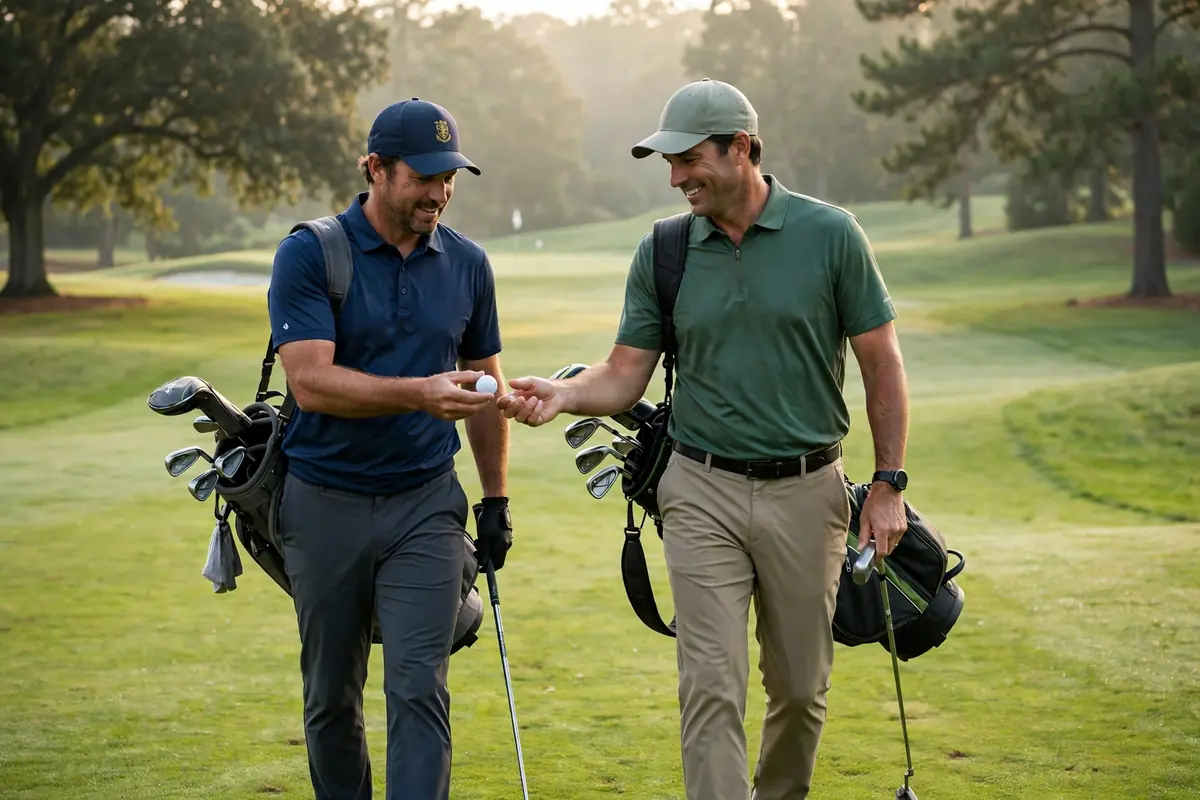
A scratch golfer is defined as a player who can play to a Course Handicap of zero on any and all rated golf courses. In practical terms, this means a scratch golfer is expected to shoot even par (or very close to it) on a golf course of standard playing difficulty. Achieving a zero handicap is one of the most coveted milestones in amateur golf, representing a level of consistency, ball-striking ability, and mental toughness that the vast majority of recreational players will never reach.
When golfers discuss a “scratch golfer,” they are referring to a specific benchmark within the World Handicap System. The term itself originated from early handicap systems where the best players teed off from a literal line scratched into the dirt, receiving no head starts or advantages. Today, understanding the distinction between a scratch golfer and a standard handicap golfer is crucial for setting realistic improvement goals. This guide breaks down the data behind scratch golf, how rare these players actually are, and the statistical differences that separate them from the rest of the golfing population.
What Is a Scratch Golfer?
Defining Zero Handicap
Under the World Handicap System (WHS) governed by the USGA and R&A, a scratch golfer is an amateur player with a Handicap Index of exactly 0.0. Because the handicap system measures a golfer’s demonstrated potential ability rather than their average score, a scratch golfer does not shoot exactly par every single time they play.
Instead, a handicap of 0.0 means that when a scratch golfer plays well (specifically, their best 8 rounds out of their last 20), their scores will align with the Course Rating. For example, if a scratch golfer plays a difficult course with a par of 72 but a Course Rating of 74.2, they are statistically expected to shoot around 74 on a good day. Conversely, on an easier par-72 course with a rating of 69.8, they should be shooting under par.
A scratch golfer possesses a complete game. They hit the ball significant distances, they rarely lose golf balls off the tee, and their short game allows them to save par frequently when they miss a green in regulation. They are the benchmark against which all golf courses are rated; the Course Rating itself is literally defined as the expected score for a scratch golfer under normal playing conditions.
Scratch Golfer vs Handicap Golfer: Key Differences
Skill Gap Between Handicap Levels
The gap between a scratch golfer and an average handicap golfer is immense, extending far beyond simply hitting the ball further. The primary differentiator is consistency and the ability to avoid catastrophic penalty strokes.
Consider the difference between a scratch golfer and a 15-handicap player (which is near the average for adult males). A 15-handicapper is capable of hitting beautiful, professional-looking shots. However, over the course of 18 holes, the 15-handicapper will inevitably hit several severely errant shots that result in double or triple bogeys. The scratch golfer almost never records a score worse than a bogey.
| Feature | Scratch Golfer (0.0 Index) | Average Golfer (15.0 Index) | Key Difference |
|---|---|---|---|
| Double Bogeys | Extremely rare (maybe 1 per round) | Common (3-5 per round) | Error mitigation and recovery skills |
| Penalty Strokes | Almost zero | Frequent (lost balls, water hazards) | Directional control off the tee |
| Up-and-Down % | High (often over 50%) | Low (struggles to chip close) | Short game precision |
| Mental Approach | Plays conservatively to targets | Aims at every pin regardless of risk | Course management and discipline |
If you want to understand where the average golfer sits and what constitutes a “good” player, you can read our guide on what constitutes a good handicap. The data shows that the leap from a “good” single-digit handicap (like an 8 or 9) to a true scratch golfer requires an exponential increase in skill and practice time.
What Does a Scratch Golfer Shoot? Score Chart by Course
A scratch golfer does not shoot par everywhere. Their target is the Course Rating, so the same player scores differently on an easy course and a hard one. On a par-72 course, a scratch golfer’s Course Handicap is simply the Course Rating minus par, rounded to a whole number.
| Course Rating (par 72) | Scratch golfer’s Course Handicap | Typical score range |
|---|---|---|
| 69.8 (easy) | +2 (gives 2 strokes) | 70 – 72 |
| 71.0 | +1 (gives 1 stroke) | 71 – 73 |
| 72.0 (standard) | 0 | 72 – 74 |
| 73.4 | 1 | 73 – 75 |
| 74.6 (hard) | 3 | 75 – 77 |
| 76.0 (championship tees) | 4 | 76 – 78 |
The low end of each range is a good day, about the Course Rating itself; the high end is a more ordinary round. Find the rating of your own course and tees with our Course Rating and Slope Calculator.
See the hardest golf courses in the US.
Plus Handicaps: Better Than Scratch
A golfer whose Handicap Index is below 0.0 has a plus handicap, written with a plus sign, such as +2.4. Instead of receiving strokes, a plus-handicap golfer gives them: in net competitions their handicap is added to their score. A player off +2 who shoots 70 has a net score of 72.
| Handicap Index | Who plays off it | Typical score on a standard par-72 course |
|---|---|---|
| 0.0 (scratch) | The top 1–2% of golfers who keep a handicap | 72 – 74 |
| +1 to +2 | Club champions and strong county players | 70 – 73 |
| +2 to +5 | Top amateurs and Division I college players | 68 – 72 |
| +5 to +8 | Tour professionals (if they kept a WHS handicap) | 65 – 70 |
“Scratch” in Competitions: Gross Scoring
The word scratch has a second meaning on the entry sheet. A scratch competition or scratch prize is decided on gross scores, with no handicap strokes at all, so the lowest actual score wins regardless of handicap. Many club events award both a scratch (gross) prize and a handicap (net) prize. In Spain and France this is the most common use of the word: “clasificación scratch” and “classement scratch” simply mean the gross leaderboard.
If you want to see how gross and net scores and handicap strokes work on a real card, read our guide on how to keep score in golf, and see where you stand today on the handicap-by-handicap chart. Team events use handicaps too — learn more about shamble.
What’s YOUR handicap? Calculate it free →
How Rare Is a Scratch Golfer?
Percentage of Golfers at Each Level
If you play at a local municipal course, you might go weeks without seeing a true scratch golfer. The statistics provided by the USGA highlight exactly how rare this level of proficiency is among the general golfing public.
According to USGA handicap distribution data, only about 2% of all male golfers who maintain an official handicap are scratch (0.0) or better. The number is even smaller for women, with less than 1% of female golfers reaching the scratch benchmark. It is important to remember that this data only includes golfers dedicated enough to maintain an official handicap. If you factored in the millions of casual golfers who do not keep a handicap, the percentage of true scratch golfers drops to a tiny fraction of one percent.
When you encounter a scratch golfer in the wild, you are watching someone who is in the top 2% of the sport. While they are not professionals, they are elite amateurs who likely played high school or college golf, or who have dedicated thousands of hours to practice.
What It Takes to Reach Scratch
Typical Practice Routines of Scratch Golfers
Reaching a zero handicap does not happen by accident, nor does it happen simply by playing 18 holes every Saturday. It requires a structured, purposeful practice routine that addresses weaknesses systematically.
Most golfers who reach scratch have spent a minimum of 10 to 20 years playing the game, though exceptions exist for highly athletic individuals who take up the sport with intense dedication. A scratch golfer’s practice routine usually flips the script on the average amateur. While a 15-handicapper might spend 80% of their practice time on the driving range hitting a driver, a scratch golfer typically spends 60% to 70% of their practice time on the short game (chipping, pitching, and putting from inside 100 yards).
Furthermore, reaching scratch almost always requires professional instruction. The golf swing mechanics required to consistently shoot even par are highly technical. A player must understand their swing path, clubface control, and angle of attack well enough to self-correct during a round when things start going wrong.
Average Scores and Statistics for Scratch Golfers
Average Driving Distance, GIR, and Putts
To understand what a scratch golfer looks like on the scorecard, we can look at the statistical averages of players carrying a 0.0 index.
Driving Distance: The average male scratch golfer drives the ball approximately 250 to 260 yards. This often surprises people who assume scratch players hit it 300 yards like PGA Tour pros. While distance helps, accuracy is far more critical.
Greens in Regulation (GIR): A scratch golfer typically hits between 10 and 12 greens in regulation per round (roughly 55% to 66%). This means they are missing 6 to 8 greens every single round. The reason they shoot even par is because they successfully get “up-and-down” to save par on the majority of those misses.
Putting: A scratch golfer averages around 29 to 31 putts per round. They rarely three-putt, and they make a very high percentage of putts from inside 10 feet.
The defining characteristic of a scratch golfer’s scorecard is the absence of high numbers. A typical round might include three birdies, three bogeys, and twelve pars. It is steady, predictable, and devoid of the dramatic blow-up holes that plague higher-handicap players.
The Path from High Handicap to Scratch
Timeline and Milestones for Improvement
If your goal is to become a scratch golfer, it is essential to understand the milestones along the way. The journey from a high handicap to scratch is not linear; the closer you get to zero, the harder it becomes to shave off a single stroke.
Phase 1: Breaking 90 (Getting to a 15-18 Handicap). This phase is achieved by keeping the ball in play off the tee and eliminating penalty strokes. You do not need a great short game; you just need to avoid losing golf balls.
Phase 2: Breaking 80 (Getting to a Single-Digit Handicap). This requires a reliable swing that produces predictable ball flights, and a solid short game. You must be able to hit the green from 150 yards out with some consistency.
Phase 3: Reaching Scratch (0.0 Handicap). This final leap is the hardest. It requires elite course management (knowing exactly where to miss), exceptional putting, and the mental toughness to bounce back immediately from a bad shot. For many players, moving from a 4 handicap to a 0 handicap takes longer than moving from a 20 to a 10.
Frequently Asked Questions
What does scratch golfer mean?
A scratch golfer is an amateur player with a Handicap Index of 0.0. It means they can play to a Course Handicap of zero on all rated golf courses, and are generally expected to shoot near the Course Rating (typically around even par) when playing well.
What percentage of golfers are scratch?
According to USGA statistics, only about 2% of male golfers and less than 1% of female golfers who maintain an official handicap are scratch or better (a “plus” handicap).
What is the average score of a scratch golfer?
Because the handicap system calculates potential based on the best 8 of the last 20 rounds, a scratch golfer’s average score is slightly higher than even par. A male scratch golfer typically averages a score of about 72 to 74 on a standard par-72 course.
Is a scratch golfer as good as a professional?
No. While a scratch golfer is an elite amateur, the gap between a scratch golfer and a touring professional is massive. If PGA Tour professionals kept WHS handicaps, they would routinely be +5.0 to +8.0. A scratch golfer would struggle to compete on a professional tour setup.
How long does it take to become a scratch golfer?
For the average adult taking up the game, it typically takes 10 to 20 years of dedicated practice and play to reach scratch, and the vast majority of players will never achieve it. Highly athletic individuals taking regular lessons might achieve it in 4 to 5 years under optimal conditions.
Can an amateur be a scratch golfer?
Yes. The term “scratch golfer” is specifically designed to measure amateur performance within the World Handicap System. Professionals do not maintain WHS handicaps in the same way, as they play strictly gross stroke play in competition.
What does a scratch golfer shoot?
On a standard par-72 course with a Course Rating of 72.0, a scratch golfer usually shoots 72 to 74. On harder courses the number rises with the Course Rating: from championship tees rated 76.0 a scratch golfer typically shoots 76 to 78.
What is a plus handicap in golf?
A plus handicap is a Handicap Index better than 0.0, written as +1, +2 and so on. A plus-handicap golfer gives strokes instead of receiving them, so their handicap is added to their gross score: a +2 player who shoots 70 has a net score of 72.
Is a 0 handicap the same as scratch?
Yes. A scratch golfer is a player with a Handicap Index of 0.0. Anyone better than that has a plus handicap.
What does scratch mean in a golf competition?
It means gross scoring. A scratch competition or scratch prize goes to the lowest actual score, with no handicap strokes applied.
What is a scratch handicap in golf?
A scratch handicap is a 0.0 Handicap Index. The player receives no strokes in net competitions — and on easier courses, they actually give strokes back as a ‘plus’ player.
What’s the difference between scratch and plus handicap?
A plus handicap (e.g. +2) is better than scratch. Plus-handicap players add strokes to their gross score in net events, while scratch players play straight up at zero.
What handicap is a bogey golfer?
A bogey golfer is roughly a 20-handicap player for men — the benchmark player the USGA uses to calculate Slope Rating.
How many golfers are scratch?
About 2% of golfers with an official Handicap Index are scratch (0.0) or better, per USGA data; among all golfers, including those who never keep a handicap, the share is far smaller.
Try our free calculators: Golf Handicap Calculator · Stableford Calculator · Golf Score Calculator
Conclusion
Reaching scratch golfer status is a monumental achievement that places a player in the top fraction of a percent of the golfing world. It represents a mastery of the physical mechanics of the golf swing, an elite short game, and a disciplined mental approach to course management.
However, understanding what a scratch golfer is should not discourage the average player. The beauty of the World Handicap System is that a 20-handicap golfer can tee it up alongside a scratch golfer, apply their strokes where they fall on the scorecard, and enjoy a perfectly fair, competitive match. Use the scratch golfer not as a source of frustration, but as a benchmark to understand the statistics of the game and to set realistic, data-driven goals for your own improvement.