
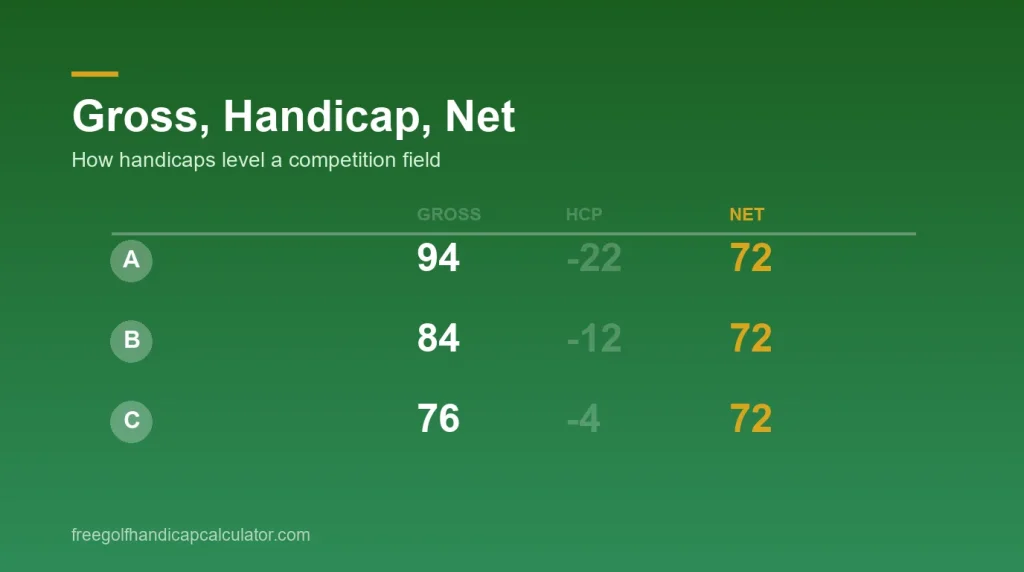
Understanding Handicap Index is one thing, but applying it correctly in a competitive environment is another. Whether you are playing in a local club championship, a charity scramble, or a serious amateur event, the way your handicap translates to a final net score depends heavily on the tournament format.
Golf tournaments use specific rules to ensure equity across the field. To level the playing field, the World Handicap System (WHS) employs handicap allowances—mathematical adjustments that account for the natural scoring variability between low-handicap and high-handicap players.
In this guide, we break down exactly how handicaps work in golf tournaments, the current recommended handicap allowances for various formats, and how a Tournament Committee applies these rules to create a fair competition.
1. How Does a Golf Handicap Work in a Tournament?
To understand how handicaps function in a tournament, you must follow the three-step conversion process dictated by the Rules of Handicapping:
- Handicap Index: Your baseline measurement of potential ability, calculated from your best recent Score Differentials.
- Course Handicap: Your Handicap Index adjusted for the specific Course Rating, Slope Rating, and Par of the tees being played.
- Playing Handicap: Your Course Handicap multiplied by a specific handicap allowance based on the tournament format.
In casual play, many golfers simply use their Course Handicap. In official tournaments, however, your Playing Handicap determines how many strokes you actually receive or give during the round.
2. Course Handicap vs Playing Handicap
The distinction between Course Handicap and Playing Handicap is the most misunderstood concept in competitive golf.
Your Course Handicap tells you exactly how many strokes you need to play to par on a specific set of tees. It is the number you use to determine your maximum hole score (Net Double Bogey) for posting a score.
Your Playing Handicap is the number of strokes you actually use during the competition to calculate your net score. If a tournament uses a 95% handicap allowance, your Playing Handicap will be 95% of your Course Handicap. (Note: Under current WHS rules, the allowance percentage is applied to the unrounded Course Handicap to prevent double-rounding errors.)
To calculate your exact Playing Handicap quickly and accurately, use our Playing Handicap Calculator.
3. What Is a Handicap Allowance?
A handicap allowance is a percentage applied to a player’s Course Handicap to determine their Playing Handicap for a specific competition format.
But why do they exist? Why not just let everyone use 100% of their Course Handicap?
Allowances exist for equity. Statistical data shows that higher-handicap players have a much wider scoring variance than lower-handicap players. On their absolute best days, a 20-handicap might shoot a net 65, whereas a 2-handicap’s best day might be a net 69. Over a large field, if everyone received 100% of their handicap in a stroke play event, the higher-handicap players would win a disproportionate number of times.
Applying an allowance (such as 95% in individual stroke play) slightly reduces the number of strokes higher-handicap players receive, statistically balancing the field so players of all abilities have an equal chance of winning.
4. Tournament Handicap Allowances
The USGA and R&A provide recommended handicap allowances in Appendix C of the Rules of Handicapping. A Tournament Committee should specify the chosen allowance in the Terms of the Competition.
Here are the current recommended allowances for common formats:
| Format | Recommended Handicap Allowance | How It Is Applied | Calculator / Guide |
|---|---|---|---|
| Individual Stroke Play | 95% | Applied to unrounded Course Handicap | Playing Handicap Calc |
| Individual Stableford | 95% | Applied to unrounded Course Handicap | Stableford Calc |
| Individual Match Play | 100% | Lowest playing handicap plays off zero | Match Play Guide |
| Four-Ball Stroke Play (4BBB) | 85% | Applied to each partner individually | 4BBB Calc |
| Foursomes (Alternate Shot) | 50% of combined team handicap | Applied to the sum of both Course Handicaps | Foursomes Calc |
| Greensomes | 60% low / 40% high | Applied to individual Course Handicaps, then added | Greensomes Calc |
| Scramble (4 players) | 25% / 20% / 15% / 10% | Applied from lowest to highest handicap | Scramble Calc |
Source: USGA/R&A Rules of Handicapping, Appendix C (Current Recommendations).
5. How Handicaps Work in Individual Stroke Play
In individual stroke play tournaments (where players record a score on every hole), the recommended allowance is 95%.
If you have an unrounded Course Handicap of 14.6, your Playing Handicap is 95% of 14.6, which equals 13.87, rounded to 14. You will receive 14 strokes for the tournament (one on the 14 hardest holes as ranked on the scorecard). Your final net score is your gross score minus 14.
Committee Discretion: The 95% recommendation is designed for medium-to-large fields. If a club is running a small stroke-play event, the Committee may choose to use 100% of Course Handicaps, as the statistical advantage of high handicappers is less pronounced in small fields.
6. How Handicaps Work in Match Play
In individual match play, you play directly against one opponent rather than the entire field. The recommended allowance is 100%.
Instead of both players subtracting their full Playing Handicap from their total score, strokes are allocated relatively. The player with the lowest Playing Handicap plays off a handicap of zero. The other player receives strokes equal to the difference between the two Playing Handicaps.
For example, if Player A has a Playing Handicap of 5 and Player B has a Playing Handicap of 12, Player A gives Player B 7 strokes (one stroke on the 7 hardest holes).
7. How Handicaps Work in Team Competitions
Team events involve complex allowance rules because the combined abilities of the team alter the statistical probability of making a low score. Instead of manually calculating these, we recommend using our dedicated format calculators:
- Four-Ball (4BBB): Both partners play their own ball, and the team counts the best net score on each hole. The recommended allowance is 85% for stroke play. (Use the 4BBB Handicap Calculator).
- Foursomes (Alternate Shot): Two players hit alternate shots with one ball. The allowance is 50% of the combined Course Handicaps. (Use the Foursomes Handicap Calculator).
- Greensomes: Both players drive, choose the best drive, and alternate shots from there. The allowance is heavily weighted toward the better player: 60% of the lower handicap plus 40% of the higher handicap. (Use the Greensomes Handicap Calculator).
- Scrambles: The most popular charity format. A standard 4-person scramble uses a step-down allowance: 25% (lowest player) / 20% / 15% / 10% (highest player). (Use the Scramble Handicap Calculator).
8. Why Tournament Handicap Allowances Exist
As mentioned earlier, the core reason for handicap allowances is to provide statistical equity. If a tournament fields 100 players ranging from scratch to 36-handicap, and everyone receives 100% of their Course Handicap, historical data dictates that a higher-handicap player is overwhelmingly likely to shoot the lowest net score of the day.
A scratch golfer is remarkably consistent; their score variance is small. A 25-handicap is highly inconsistent; they might shoot 110, or they might shoot 92. In a large field, the odds that at least one 25-handicap player will have the “round of their life” (shooting far below their handicap) are very high. Applying a 95% allowance to the entire field slightly compresses the advantage of that extreme variance.
9. How a Tournament Committee Sets Handicap Allowances
A Tournament Committee is the governing body for a specific event. While the USGA and R&A provide recommended allowances, the Committee ultimately defines the exact rules in the Terms of the Competition.
The Committee may adjust allowances based on:
- Field Size: Small fields may use 100% instead of 95% for individual stroke play.
- Divisions/Flights: If a tournament is heavily flighted (where a 5-handicap only competes against other 3-to-7 handicaps), the Committee might choose to use 100% because the scoring variance within a narrow flight is minimal.
- Format Variations: A Committee might cap maximum handicaps for a specific event to ensure pace of play.
10. Example: From Handicap Index to Tournament Playing Handicap
(This is an illustrative example of the standard calculation method per USGA Rule 6.2a.)
A player with a Handicap Index of 15.2 is entering an individual stroke play tournament. The Course Rating is 71.5, Slope Rating is 125, and Par is 72. The tournament uses the recommended 95% handicap allowance.
- Calculate Unrounded Course Handicap:
(Handicap Index x (Slope Rating ÷ 113)) + (Course Rating – Par)
(15.2 x (125 ÷ 113)) + (71.5 – 72)
16.814 + (-0.5) = 16.314 - Apply Handicap Allowance:
16.314 x 95% (0.95) = 15.498 - Round to Nearest Whole Number:
15.498 rounds to 15.
The player’s Playing Handicap for the tournament is 15. To skip the manual math, simply input your numbers into our Course Handicap Calculator and Playing Handicap Calculator.
11. What About Plus Handicaps in Tournaments?
Players with a “plus” handicap (meaning they are better than scratch and their Index is preceded by a “+”) must also apply handicap allowances in tournaments.
According to current Appendix C guidance, when a handicap allowance is applied to a plus handicap, the resulting Playing Handicap moves upward toward zero. Because the allowance is a fraction of the handicap, taking 95% of a negative number brings it closer to zero.
For example, if a plus-handicap player has an unrounded Course Handicap of +3.4, a 95% allowance makes it +3.23, which rounds to a Playing Handicap of +3. This means they must add 3 strokes to their gross score to determine their net score.
12. Common Tournament Handicap Mistakes
Tournament players frequently make errors when calculating their strokes. Avoid these common pitfalls:
- Confusing Handicap Index with Course Handicap: Your Index is a baseline (e.g., 12.4), but you must convert it to a Course Handicap based on the tees you are playing.
- Ignoring the Playing Handicap: Do not just use your Course Handicap. Always check the Terms of the Competition for the applicable handicap allowance.
- Applying Allowances to the Rounded Course Handicap: If you round your Course Handicap first, and then apply 95%, you are double-rounding, which can result in an incorrect Playing Handicap. Always apply the allowance to the unrounded calculation.
- Assuming 95% Applies to Everything: 95% is for individual stroke play. Four-ball is 85%. Always verify the format.
13. Frequently Asked Questions
What handicap do I use in a golf tournament?
You use your Playing Handicap, which is calculated by applying the tournament’s designated handicap allowance (such as 95%) to your Course Handicap for the specific tees being played.
Is tournament handicap the same as Course Handicap?
Not usually. While your Course Handicap determines how many strokes you need to play to par, your tournament Playing Handicap is often a reduced percentage of that number, depending on the format.
What is the 95% handicap allowance?
It is the standard recommended allowance for individual stroke play and Stableford competitions under the WHS. It slightly reduces strokes given to higher-handicap players to ensure statistical equity across large fields.
What handicap allowance is used in match play?
For individual match play, the recommended allowance is 100%. The player with the lower Playing Handicap plays off zero, and the higher handicap receives the difference between their respective handicaps.
How does four-ball handicap work?
In Four-Ball (4BBB) stroke play, each partner receives 85% of their unrounded Course Handicap. They play their own balls, and the lowest net score on the hole counts for the team.
Can a tournament use a different handicap allowance?
Yes. The Tournament Committee has the final authority to adjust handicap allowances in the Terms of the Competition based on field size, flighting, or other competitive factors.
What happens to plus handicaps?
When a fractional allowance (like 95%) is applied to a plus handicap, the number moves closer to zero. For example, +4.2 becomes +3.99, which rounds to a Playing Handicap of +4.

