
4BBB Handicap Calculator (Four-Ball Better Ball)
Calculate individual Four-Ball Playing Handicaps using WHS allowances. Also written fourball or four ball better ball.
Team Handicap Calculation
Calculate individual Four-Ball Playing Handicaps based on format allowance
How It Works
Player Handicaps
Enter each player's Handicap Index.
WHS Allowances
Stroke Play uses an 85% allowance. Match Play uses a 90% allowance.
Individual Calculation
Each player's exact Course Handicap is calculated independently before the allowance is applied.
WHS Compliant
Follows the R&A/USGA recommended 4BBB allowance procedure.
What Is a 4BBB Handicap Calculator?
A 4BBB handicap calculator (Four-Ball Better Ball) is an essential tool designed to calculate the individual Playing Handicaps for two golfers competing as a team in a Four-Ball format. In a Four-Ball competition, each player plays their own golf ball throughout the round, and the team’s score on each hole is the lower of the two players’ net scores.
Unlike some other team formats, Four-Ball does not combine the players’ Handicap Indexes into a single team handicap. Instead, this calculator determines a specific Playing Handicap for each golfer based on their own Handicap Index, the difficulty of the golf course, and the official allowance mandated for the format.
How Does a 4BBB Handicap Calculator Work?
To accurately determine the Playing Handicaps for your team, the calculator requires a few standard inputs. You will need to enter Player A’s Handicap Index, Player B’s Handicap Index, the Course Rating, the Slope Rating, and the Par for the tees being played. You must also select the specific Four-Ball format you are playing.
Calculate Each Player’s Course Handicap
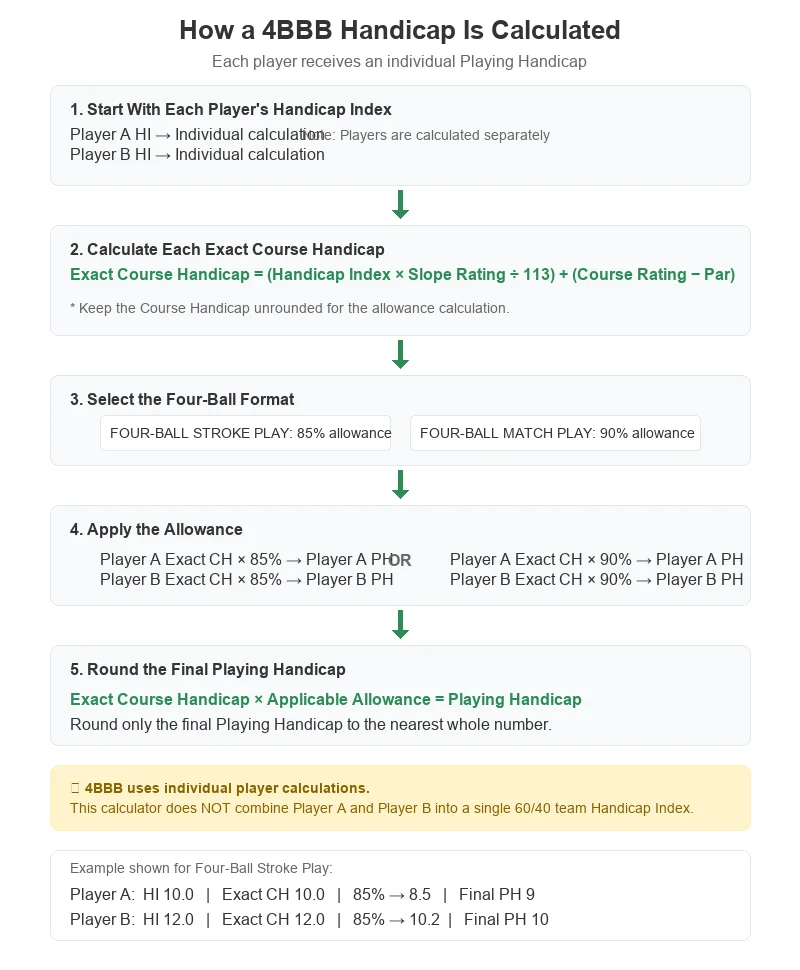
First, Player A and Player B are calculated entirely independently. The tool calculates an exact, unrounded Course Handicap for each golfer using the standard formula:
Exact Course Handicap = (Handicap Index × Slope Rating ÷ 113) + (Course Rating – Par)
Note that a Handicap Index of 0.0 (a scratch golfer) is perfectly valid and supported by the calculator.
Apply the Four-Ball Allowance
Because players in a Four-Ball team can rely on their partner if they have a bad hole, playing to a full 100% handicap would give teams an unfair statistical advantage. To correct this, the calculator automatically applies a percentage reduction known as a handicap allowance to each player’s exact Course Handicap.
Four-Ball Stroke Play vs Match Play
The WHS rules mandate different allowances depending on whether your team is playing Stroke Play or Match Play. The calculator handles these adjustments automatically when you select your format:
- Four-Ball Stroke Play: The calculator applies an 85% allowance to each player’s exact Course Handicap.
- Four-Ball Match Play: The calculator applies a 90% allowance to each player’s exact Course Handicap.
Do not confuse these team allowances with the individual Playing Handicap allowances used in singles competitions (which are typically 95% for Stroke Play and 100% for Match Play).
How the 4BBB Results Are Calculated
The mathematical sequence must be executed in a specific order to prevent compound rounding errors. The calculator uses the exact, unrounded Course Handicap before applying the allowance, and only rounds the final result.
Consider this mathematically verified example for a Four-Ball Stroke Play competition:
- Player A: 10.0 Handicap Index
- Player B: 12.0 Handicap Index
- Course details: 72.0 Course Rating, 113 Slope Rating, Par 72
Player A Calculation:
Exact Course Handicap = (10.0 × 113 ÷ 113) + (72.0 – 72) = 10.0
Allowance = 10.0 × 85% = 8.5
Final Playing Handicap = 9 (rounded from 8.5)
Player B Calculation:
Exact Course Handicap = (12.0 × 113 ÷ 113) + (72.0 – 72) = 12.0
Allowance = 12.0 × 85% = 10.2
Final Playing Handicap = 10 (rounded from 10.2)
4BBB Handicap vs Other Team Formats
It is important to remember that Four-Ball uses independent calculations for each player. Other team formats use entirely different methodologies that blend the players’ indexes together. For example:
- The Foursomes Handicap Calculator combines 50% of the combined team Course Handicap.
- The Greensomes Handicap Calculator uses a 60% / 40% split of the lower and higher Course Handicaps.
This 4BBB tool does not use a combined 60/40 formula. It strictly calculates independent Player A and Player B Playing Handicaps.
A Worked Example on a Real Course
The example above uses a course with a Slope Rating of 113 and a Course Rating equal to par, which keeps the arithmetic simple but hides it: on that course a Course Handicap is identical to the Handicap Index, so nothing has to be worked out. A real course is where the allowance actually bites.
Take a par 71 course with a Slope Rating of 132 and a Course Rating of 70.6, played as Four-Ball Stroke Play. Player A has a Handicap Index of 11.0; Player B has 24.8.
Step 1 — each player’s exact Course Handicap
- Player A: (11.0 × 132 ÷ 113) + (70.6 − 71) = 12.8496 − 0.4 = 12.4496
- Player B: (24.8 × 132 ÷ 113) + (70.6 − 71) = 28.9699 − 0.4 = 28.5699
Step 2 — apply the 85% Four-Ball Stroke Play allowance
- Player A: 12.4496 × 0.85 = 10.5821, rounded = 11
- Player B: 28.5699 × 0.85 = 24.2844, rounded = 24
Why doing this from your scorecard gives the wrong answer
This is the part worth remembering. An individual Course Handicap is rounded to a whole number before it appears on a card, so on that course Player A’s reads 12 and Player B’s reads 29. Take the allowance from those printed figures and both players end up wrong:
- Player A: 12 × 0.85 = 10.2, rounded = 10 — one stroke too few
- Player B: 29 × 0.85 = 24.65, rounded = 25 — one stroke too many
The errors run in opposite directions, which is why they are so easy to miss: nothing about the pair of numbers looks obviously wrong. The allowance must be taken from the exact, unrounded Course Handicap, and the result rounded only once, at the very end. The calculator above works from the exact figures, so its answer will sometimes differ from one worked out by hand off the card.
The same pair in Match Play
Switch the format to Four-Ball Match Play and the allowance becomes 90%: Player A gets 12.4496 × 0.90 = 11.2046, or 11, and Player B gets 28.5699 × 0.90 = 25.7129, or 26.
There is a further step in match play that a calculator cannot do for you. Strokes in a handicap match are normally taken as the difference between the players: the lowest handicap in the match plays off scratch and everyone else receives the difference. If those two faced a pair whose lowest Playing Handicap was 8, then 8 becomes the baseline — Player A receives 3 strokes and Player B receives 18. The Committee can state a different method in the conditions of the competition, so check them if you are playing a formal match.
Common Mistakes in 4BBB Handicap Calculations
Taking the allowance from the rounded Course Handicap
The error shown above, and the most common of all. Round once, after the allowance, never before it.
Using the singles allowances by mistake
Individual competitions commonly use 95% for stroke play and 100% for match play. Four-Ball uses 85% and 90%. Applying the singles figures to a Four-Ball gives every player several strokes too many, because the format itself already favours the team — a bad hole from one partner costs nothing if the other scores.
Forgetting that the two formats differ
85% is Four-Ball Stroke Play; 90% is Four-Ball Match Play. It is a small gap, but on a 28-stroke Course Handicap it is worth more than a stroke, and it decides holes.
Applying the allowance to the Handicap Index
The 85% or 90% applies to the Course Handicap, not to the Handicap Index. Taking it from the Index skips the Slope Rating and the Course Rating entirely, so the answer is wrong everywhere except on a course rated 113 with a Course Rating equal to par.
Combining the two handicaps into one
Four-Ball does not produce a team handicap. Each player keeps their own Playing Handicap and plays their own ball. Blending the two — as Foursomes and Greensomes do — is a different format’s method applied to the wrong game.
4BBB Handicap: Frequently Asked Questions
Are the 85% and 90% allowances compulsory?
They are the allowances the World Handicap System recommends, and almost every club applies them. They are recommendations rather than Rules of Golf: the Committee running the competition may set something else and should say so in the conditions. Follow your club’s terms where they differ.
Can partners have very different handicaps?
Yes. Nothing in the calculation limits the gap, and the example above pairs an 11.0 with a 24.8. Some Committees do cap the difference within a team, or cap the maximum strokes a player may receive, to stop one very high handicap dominating the result. That is a local condition, not part of the handicap formula.
What if one partner is a scratch golfer?
A Handicap Index of 0.0 is perfectly valid here. The Course Handicap still moves with the Slope Rating and the Course Rating, so a scratch player will usually still have a Course Handicap that is not zero — on the course in the example it would be −0.4 before the allowance.
Can partners play from different tees?
Yes, and it changes nothing about the method. Each player’s Course Handicap comes from the Slope Rating and Course Rating of the tees that player uses, so enter each set separately. The allowance is then applied to each player’s own figure.
Where do the strokes fall during the round?
Each player receives their strokes against the holes’ Stroke Index, individually. Unlike Foursomes or Greensomes, the strokes belong to the player rather than the team, because each player is holing out their own ball. The team’s score on a hole is then the better of the two net scores.
Does Four-Ball Stableford use the same allowance?
Four-Ball Stableford is a form of stroke play, so the 85% allowance applies. Each player’s net score on a hole converts into Stableford points as usual, and the team records the higher of the two point totals on each hole.