
Greensomes Handicap Calculator
Calculate the combined team handicap for Greensomes competition where both drive and the best tee shot is selected.
Greensomes / Alternate Shot
Playing Handicap = 60% of the lower Course Handicap + 40% of the higher Course Handicap
How It Works
Player HIs
Enter both players' Handicap Indexes.
Course Handicap
Each player's Handicap Index is independently converted into an exact Course Handicap.
60/40 Split
The lower Course Handicap contributes 60%, higher contributes 40%.
Final Rounding
The weighted combination is rounded once at the very end to determine the Playing Handicap.
What Is a Greensomes Handicap Calculator?
A Greensomes handicap calculator is a tool designed to determine the official team playing handicap for the Greensomes golf format. In a Greensomes competition, both partners tee off on every hole. The team selects the best drive, and players play alternate shots from that point until the ball is holed. Because both players contribute to the tee shot, the handicap methodology requires a formula that balances the abilities of both golfers.
In this format, the two players form a single team. While both players maintain an individual Handicap Index, the team requires a single combined handicap. The Greensomes format uses a specific WHS-based methodology that applies a 60/40 allowance to each player’s individually calculated Course Handicap to produce a fair final team handicap.
How Does a Greensomes Handicap Calculator Work?
The calculation process involves distinct steps to ensure mathematical accuracy according to the World Handicap System.
Calculate Each Player’s Course Handicap
The first step is determining the exact Course Handicap for both partners. Each player’s Course Handicap is calculated independently using the formula:
Course Handicap = (Handicap Index × Slope Rating ÷ 113) + (Course Rating − Par)
It is critical that the calculator uses these exact, unrounded Course Handicap values for the subsequent team calculation. Rounding at this stage would introduce mathematical errors.
Identify the Lower and Higher Course Handicaps
Once exact Course Handicaps are calculated, the system identifies which player has the lower Course Handicap and which has the higher Course Handicap. This step is essential because the Greensomes 60/40 allowance applies different weights to these two values. The lower and higher comparison is performed exclusively on the Course Handicaps, not on Handicap Indexes.
How Is the Greensomes 60/40 Handicap Calculated?
The team’s final playing handicap is produced by applying the Greensomes 60/40 allowance to the exact Course Handicaps. The formula is:
Playing Handicap = (Lower Course Handicap × 60%) + (Higher Course Handicap × 40%)
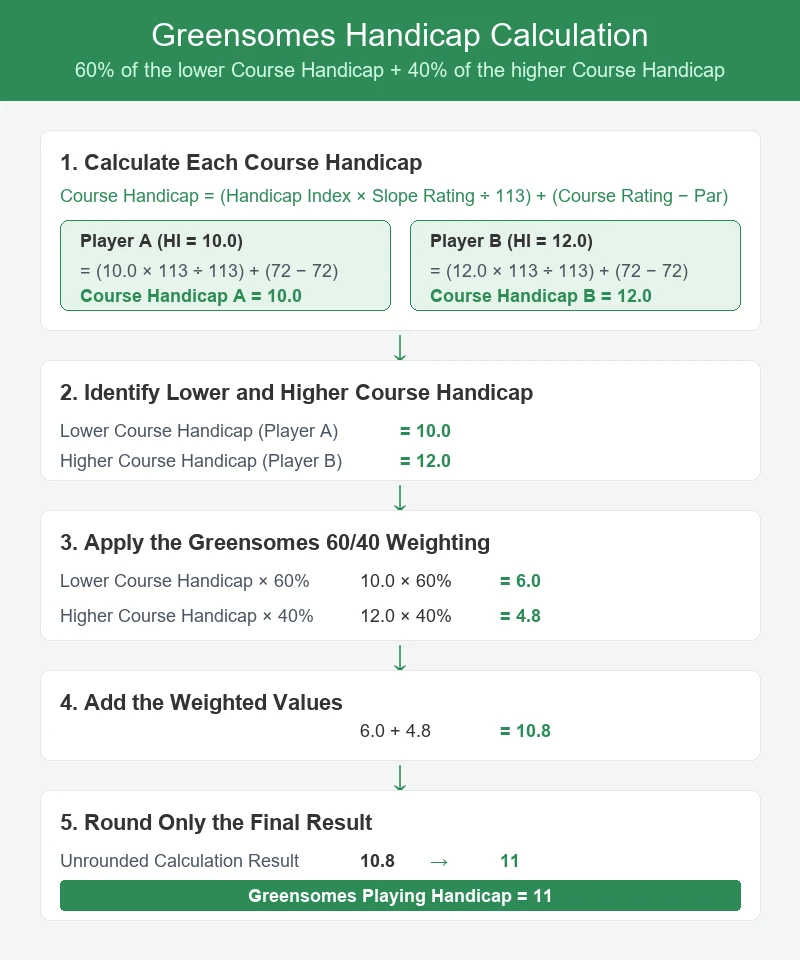
For example, suppose Player A has a Handicap Index of 10.0 and Player B has a Handicap Index of 12.0. On a course with a Slope Rating of 113, Course Rating of 72, and Par of 72:
- Player A Course Handicap = 10.0
- Player B Course Handicap = 12.0
- Lower CH = 10.0
- Higher CH = 12.0
- 10.0 × 60% = 6.0
- 12.0 × 40% = 4.8
- Combined result = 10.8
The combined result of 10.8 is rounded only at the very end. The team’s final Greensomes Playing Handicap is 11.
Greensomes vs Foursomes and Four-Ball
Understanding the difference between formats is important for applying the correct calculation.
In Greensomes, both partners tee off, the team selects one tee shot, and the partners continue with alternate shots. The calculation uses the specific Greensomes 60/40 Course Handicap methodology.
In traditional Foursomes, partners play alternate shots from the very start, meaning only one player tees off per hole. You should use a Foursomes Handicap Calculator instead.
Four-Ball, or 4BBB, is an entirely different format where each player plays their own ball throughout. Players receive individual playing handicaps. For that format, use a 4BBB Handicap Calculator.
Greensomes Handicap vs Course Handicap
A frequent point of confusion is the difference between an individual Course Handicap and the final Greensomes handicap. A Course Handicap is the individual value calculated from a player’s Handicap Index, the Slope Rating, the Course Rating, and Par.
In contrast, the Greensomes Playing Handicap Calculator result is the final team handicap. This team handicap is produced by applying the 60/40 weighting exclusively to the lower and higher Course Handicaps. You do not use your raw Course Handicap directly.
A Worked Example on a Real Course
Most Greensomes examples use a course with a Slope Rating of 113 and a Course Rating equal to par. That is convenient, but it hides the arithmetic: on such a course every Course Handicap is identical to the Handicap Index, so the numbers never actually change. A real course behaves differently, and that is where most manual calculations go wrong.
Take a par 72 course with a Slope Rating of 125 and a Course Rating of 71.9. Player A has a Handicap Index of 7.9; Player B has a Handicap Index of 18.7.
Step 1 — each player’s exact Course Handicap
Course Handicap = (Handicap Index × Slope Rating ÷ 113) + (Course Rating − Par)
- Player A: (7.9 × 125 ÷ 113) + (71.9 − 72) = 8.7389 − 0.1 = 8.6389
- Player B: (18.7 × 125 ÷ 113) + (71.9 − 72) = 20.6858 − 0.1 = 20.5858
Step 2 — apply the 60/40 allowance
- Lower Course Handicap × 60% = 8.6389 × 0.60 = 5.1833
- Higher Course Handicap × 40% = 20.5858 × 0.40 = 8.2343
- Combined = 13.4177, rounded once at the end = 13
Why the number on your scorecard can mislead you
This is the part worth remembering. On that course Player A’s Course Handicap is displayed as 9 and Player B’s as 21, because an individual Course Handicap is rounded to a whole number before it goes on a card. If you take those two rounded figures and do the arithmetic yourself:
(9 × 0.60) + (21 × 0.40) = 5.4 + 8.4 = 13.8, which rounds to 14.
That is one stroke more than the correct answer of 13 — enough to decide a close match. The 60/40 allowance must be applied to the exact, unrounded Course Handicaps, and the result rounded only once, at the very end. The calculator above does this for you, which is why its answer will sometimes differ from a figure worked out by hand from the rounded numbers on the card.
Common Mistakes in Greensomes Handicap Calculations
Rounding too early
By far the most frequent error, and the one shown above. Round once, at the end, and never before the 60/40 split.
Using Handicap Indexes instead of Course Handicaps
The 60/40 allowance applies to Course Handicaps, not to Handicap Indexes. Applying it to the Indexes ignores the Slope Rating and the Course Rating entirely, so the team handicap will be wrong on every course except one rated 113 with a Course Rating equal to par.
Giving 60% to the wrong player
The lower Course Handicap takes 60% and the higher takes 40%, not the other way round. Reversing them inflates the team handicap. In the example above, the reversed calculation gives (8.6389 × 0.40) + (20.5858 × 0.60) = 15.8, rounding to 16 — three strokes too many.
Comparing the wrong pair of numbers
Decide who is “lower” by comparing Course Handicaps, not Handicap Indexes. The two normally agree, but they do not have to: if partners play from different tees, the player with the lower Index can end up with the higher Course Handicap.
Borrowing the Foursomes allowance
Foursomes uses 50% of the two combined Course Handicaps. Greensomes uses 60/40. The formats look similar — both end in alternate shots — but the allowances are different because in Greensomes both partners hit a tee shot and the team keeps the better one.
Greensomes Handicap: Frequently Asked Questions
Is the 60/40 split an official rule?
It is the allowance the World Handicap System recommends for Greensomes, and it is what almost every club applies. It is a recommendation rather than a Rule of Golf: the Committee running a competition may set a different allowance, and should say so in the conditions. If your club’s terms specify something else, follow those.
What if both partners have the same Handicap Index?
If both play from the same tees, their Course Handicaps are identical, so 60% and 40% of the same number add back up to 100% of it. The team’s Playing Handicap is simply that Course Handicap. The 60/40 split only starts to matter once the two differ.
Where do the strokes actually fall during the round?
The team receives its strokes against the holes’ Stroke Index in the usual way: the Playing Handicap determines how many strokes the team gets, and those are allocated to the lowest-numbered stroke index holes. Because the partners play a single ball, the strokes belong to the team, not to either player.
Can partners play from different tees?
Yes, and the calculation still holds, because each player’s Course Handicap is worked out from the Slope Rating and Course Rating of the tees that player uses. Enter each player’s own figures. This is the case where the lower Handicap Index does not always produce the lower Course Handicap, so check which is actually lower before splitting 60/40.
What if one partner does not have a Handicap Index?
A player without a Handicap Index has no Course Handicap, so there is nothing to put into the formula. In practice the Committee assigns that player a handicap for the day, and the 60/40 calculation then runs on that figure. An informal match can agree any number both sides accept — but it is an estimate, not a WHS handicap.
Does the answer change if we play Stableford instead of stroke play?
The team’s Playing Handicap is calculated the same way. What changes is how the score is recorded afterwards: the strokes still fall by Stroke Index, and the team’s net score on each hole converts into Stableford points as usual.