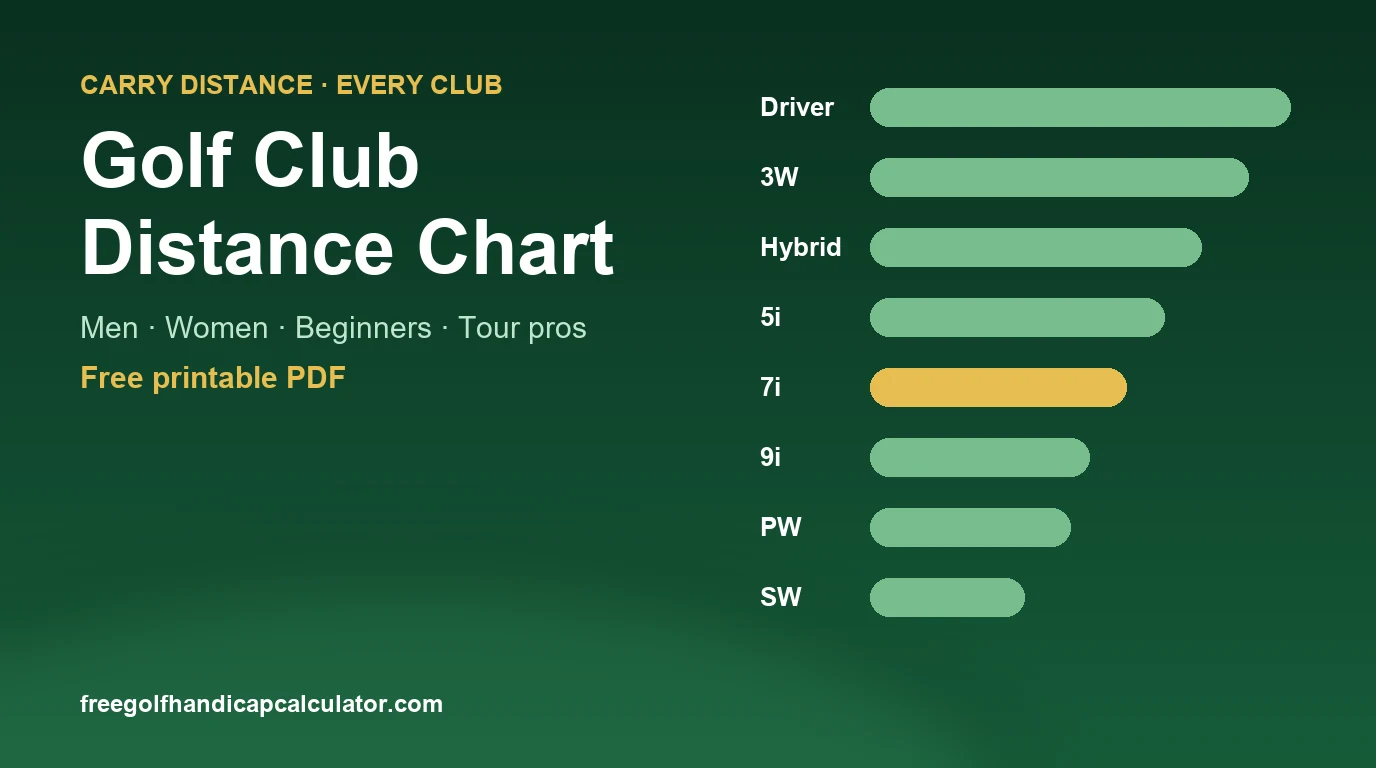
The average male amateur carries a driver about 215 to 235 yards and a 7-iron about 130 to 145 yards. The average female amateur carries a driver about 140 to 160 yards and a 7-iron about 85 to 100 yards. The full chart for every club is below, followed by tour averages, a swing-speed chart and a printable version you can fill in with your own numbers.
Every figure is carry distance (how far the ball flies before it lands), because that is the number that decides whether you clear a bunker or reach a green. Roll adds more, mostly with the driver and woods.
Golf Club Distance Chart for Men, Women and Beginners
Typical carry distances in yards. These are ranges, not targets: two golfers with the same handicap can be 20 yards apart with the same club.
| Club | Men (average amateur) | Women (average amateur) | Beginner |
|---|---|---|---|
| Driver | 215 – 235 | 140 – 160 | 170 – 200 |
| 3-wood | 195 – 210 | 125 – 140 | 150 – 175 |
| 5-wood | 180 – 195 | 115 – 130 | 140 – 160 |
| Hybrid (3/4) | 170 – 185 | 105 – 120 | 130 – 150 |
| 4-iron | 160 – 175 | — | — |
| 5-iron | 150 – 165 | 100 – 115 | 120 – 140 |
| 6-iron | 140 – 155 | 95 – 105 | 110 – 130 |
| 7-iron | 130 – 145 | 85 – 100 | 100 – 120 |
| 8-iron | 120 – 135 | 80 – 90 | 90 – 110 |
| 9-iron | 110 – 125 | 70 – 85 | 80 – 100 |
| Pitching wedge | 100 – 115 | 60 – 75 | 70 – 90 |
| Gap wedge | 90 – 100 | 50 – 65 | 60 – 80 |
| Sand wedge | 75 – 90 | 40 – 55 | 50 – 70 |
| Lob wedge | 60 – 75 | 30 – 45 | 40 – 55 |
Beginners often have no 4-iron in the bag, and most women replace long irons with hybrids and fairway woods, which is why those cells are empty or overlap. The steady drop of about 10 to 15 yards from one iron to the next is the pattern that matters most, and it is covered in the gapping section below.
How Far Do Tour Pros Hit Each Club?
For comparison, these are approximate average carry distances on the PGA Tour and LPGA Tour, alongside the average male amateur. A tour player hits a 7-iron about as far as an average amateur hits a hybrid.
| Club | PGA Tour | LPGA Tour | Average male amateur |
|---|---|---|---|
| Driver | 275 | 218 | 215 – 235 |
| 3-wood | 243 | 195 | 195 – 210 |
| 5-wood | 230 | 185 | 180 – 195 |
| Hybrid (3/4) | 225 | 175 | 170 – 185 |
| 4-iron | 203 | 169 | 160 – 175 |
| 5-iron | 194 | 161 | 150 – 165 |
| 6-iron | 183 | 152 | 140 – 155 |
| 7-iron | 172 | 141 | 130 – 145 |
| 8-iron | 160 | 130 | 120 – 135 |
| 9-iron | 148 | 119 | 110 – 125 |
| Pitching wedge | 136 | 107 | 100 – 115 |
The gap is not only strength. Tour players strike the centre of the face almost every time, launch the ball at the optimum angle and spin, and play equipment fitted to their swing. An amateur who improves contact usually gains more distance than one who simply swings harder.
Driver Distance by Swing Speed
Clubhead speed is the single biggest factor in how far you hit the ball. As a rule of thumb, each 1 mph of driver speed is worth about 2.3 yards of carry with solid contact. The average male amateur swings a driver at roughly 90 to 95 mph.
| Driver swing speed | Driver carry (yds) | Driver total with roll (yds) |
|---|---|---|
| 70 mph (113 km/h) | 160 | 176 |
| 80 mph (129 km/h) | 185 | 204 |
| 90 mph (145 km/h) | 205 | 226 |
| 100 mph (161 km/h) | 230 | 253 |
| 110 mph (177 km/h) | 255 | 280 |
| 120 mph (193 km/h) | 275 | 302 |
The total column assumes about 10% extra roll on firm, dry fairways. On soft or wet ground expect much less.
Carry vs Total Distance
- Carry is the distance the ball travels in the air. Use it to choose a club when there is water, a bunker or a raised green in front of you.
- Total is carry plus roll. It matters off the tee on firm courses, and much less on approach shots, where you want the ball to stop quickly.
- Launch monitors and GPS apps report both. When you build your own chart, record carry.
Club Gapping: How Far Apart Should Your Clubs Be?
A well set-up bag has an even gap of about 10 to 15 yards between each iron. Smaller gaps mean two clubs doing the same job; bigger gaps leave distances you cannot hit with a full swing.
- Under 5 yards: the clubs overlap. You could remove one and add a club where you have a hole in your distances.
- 10 to 15 yards: ideal for irons.
- Over 20 yards: a gap worth filling, usually between the pitching wedge and sand wedge (add a gap wedge) or between the longest iron and the fairway wood (add a hybrid).
Our Club Distance Calculator checks this for you: enter a few shots with each club and it shows your average for every club and flags any gap that is too small or too large.
What Changes How Far You Hit the Ball
- Temperature: cold air is denser and a cold ball is less lively. Expect a few yards less per club on a cold morning.
- Altitude: the ball flies noticeably further at altitude, roughly 2% for every 1,000 feet above sea level.
- Wind: a headwind costs more distance than the same tailwind adds.
- Lie: from the rough the ball can fly further with less spin (a “flyer”) or come out short if grass gets between club and ball.
- Strike: a shot off the toe or heel can lose 10% or more of its distance. Consistent contact matters more than raw speed.
- Loft and equipment: modern “game improvement” 7-irons often have the loft of an older 6-iron, so distances are not comparable between sets.
How to Build Your Own Club Distance Chart
- Warm up fully, then hit 5 to 10 shots with each club using a normal, full swing.
- Ignore obvious mishits. Record the carry distance of the rest from a launch monitor, range targets or a GPS app on the course.
- Use the average, not your best shot. Planning around your best 7-iron is the most common reason amateurs come up short.
- Enter the numbers in the Club Distance Calculator to check your gapping.
- Write your chart down and keep it in your bag. Update it every few months, or whenever you change clubs.
Printable Golf Club Distance Chart
Download the free printable chart: page one has the average distances above, page two is a blank chart for your own carry and total distances with every club. Both pages print cleanly on A4 or US Letter paper.
Download the printable golf club distance chart (PDF)
Distance Is Not the Same as Scoring
Longer hitters do tend to have lower handicaps, but most strokes are lost inside 100 yards. If your aim is a lower score, knowing exactly how far you hit your wedges is worth more than 10 extra yards off the tee. See how to lower your golf handicap and our practice routines, and compare your scores with the average score for your handicap.
Frequently Asked Questions
How far should I hit a 7-iron?
The average male amateur carries a 7-iron about 130 – 145 yards, and the average female amateur about 85 – 100 yards. Tour professionals average about 172 yards. Your own number depends mainly on your swing speed and how consistently you strike the ball.
How far does the average golfer hit a driver?
The average male amateur carries a driver about 215 – 235 yards, and a little further once the ball rolls out. The average female amateur carries it about 140 – 160 yards.
What is a good distance gap between golf clubs?
About 10 to 15 yards between irons. Gaps under 5 yards mean two clubs overlap, and gaps over 20 yards leave distances you cannot cover with a full swing.
Should I use carry or total distance when choosing a club?
Use carry for approach shots and whenever there is trouble in front of the green. Total distance matters mainly off the tee, where the ball has room to roll.
How far should a beginner hit each club?
A typical adult male beginner carries a driver about 170 to 200 yards and a 7-iron about 100 to 120 yards. Distances increase quickly as contact improves, so re-measure after a few months.
Why do I hit my irons shorter than the chart?
Usually because of contact rather than strength. Off-centre strikes, a steep angle of attack or low clubhead speed all reduce distance. Older or weaker-lofted irons also fly shorter than modern sets. Measure your own averages and build your game around them.
How far should a senior golfer hit each club?
Senior golfers (60+) typically hit each club 10-20 yards shorter than the average male amateur. A senior driver carry of 180-200 yards and a 7-iron of 110-125 yards is typical. Slower swing speeds and reduced flexibility account for the difference — many seniors gain distance back by switching to lighter shafts and higher-lofted clubs.
How accurate are golf club distance charts?
They show averages across thousands of golfers, so treat them as starting points, not targets. Your actual distances depend on swing speed, contact quality, equipment, and conditions. The most accurate chart is the one you build yourself by measuring your own carry distances with each club.
Why do my distances differ from the chart?
The three biggest reasons are contact quality (off-center strikes lose 10%+ distance), swing speed (below-average speed means shorter distances), and equipment (older or weaker-lofted clubs fly shorter). Temperature, altitude, and wind also matter. Measure your own numbers rather than chasing the chart.
How far should I hit my hybrid vs my longest iron?
A hybrid (3/4) typically carries 170-185 yards for the average male amateur — about 10-15 yards further than a 4-iron. Hybrids are easier to launch high and land soft, which is why most amateurs replace their 3 and 4-irons with hybrids entirely.
Do golf club distances change with age?
Yes. Golfers typically lose 2-4 yards per club per decade after age 50 due to declining swing speed. The good news: modern fitted equipment, lighter shafts, and improved technique can offset much of this loss. Re-measure your distances every couple of years.
What is the average distance for each golf club on the LPGA tour?
LPGA tour players average about 218 yards with driver, 141 yards with a 7-iron, and 107 yards with pitching wedge (carry distances). For comparison, PGA tour players average 275 yards with driver and 172 yards with a 7-iron.