If you regularly shoot around 100 on a par-72 course, your Handicap Index is usually somewhere between 23 and 26, and most golfers who card 100 consistently settle close to 25.
That is the quick answer. The exact number depends on the course you play, on whether 100 is your usual score or your best one, and on how the handicap system counts your rounds. This guide covers all three, plus what a round of 100 actually looks like and how many handicap strokes you receive with an index of 25.
Score to Handicap Chart
This chart assumes a par-72 course with a Course Rating of 72.0 and a Slope Rating of 113, the benchmark the World Handicap System is built around. On that course the Score Differential is simply your score minus 72.
| Typical score | Score Differential | Handicap Index | Where that puts you |
|---|---|---|---|
| 90 | 18.0 | 13 – 16 | Solid mid-handicapper |
| 95 | 23.0 | 18 – 21 | Mid to high handicap |
| 100 | 28.0 | 23 – 26 | High handicap |
| 105 | 33.0 | 28 – 31 | Improving beginner |
| 110 | 38.0 | 33 – 36 | Beginner |
The Handicap Index sits a few strokes below the differential of your typical score. That is not a mistake: your Handicap Index is the average of your best 8 Score Differentials out of your last 20 rounds, so it reflects your better golf rather than your everyday golf. For the full chart from 75 to 120, see what’s my handicap if I shoot 90.
Why Two Golfers Who Shoot 100 Can Have Different Handicaps
A score only means something once you know where it was played. Every set of tees has a Course Rating (what a scratch golfer is expected to shoot) and a Slope Rating (how much harder the course plays for everyone else). Your Score Differential for a round is:
Score Differential = (Adjusted Gross Score − Course Rating) × 113 ÷ Slope Rating
- 100 on an easier course, Course Rating 70.0 and Slope 115: (100 − 70.0) × 113 ÷ 115 = 29.5
- 100 on a harder course, Course Rating 73.8 and Slope 132: (100 − 73.8) × 113 ÷ 132 = 22.4
Same score, but a difference of about seven strokes in what it does to your handicap: the easier course gives the higher differential, because shooting 100 there is a weaker round. That is why any chart is an estimate. You can check a single round with our handicap differential calculator, and work out your Handicap Index from all your rounds with the free golf handicap calculator.
What a Round of 100 Looks Like
On a par-72 course, 100 is 28 over par. Spread over 18 holes, that could be ten double bogeys and eight bogeys, or a mix of pars, bogeys and a few big numbers. For most golfers in this range it is the second pattern: plenty of bogeys and the odd par, then two or three holes where a lost ball, a penalty or a run of chips and three putts costs four or five shots.
That is good news. Playing every hole in bogey is a score of 90, so a golfer who shoots 100 is not ten shots short everywhere; they are usually losing most of those shots on a handful of holes. Cutting out one triple bogey per nine is often enough to go from 100 to the mid-90s.
Is Shooting 100 Good?
For a newer golfer, yes. Breaking 100 is the first real milestone in golf. Commonly quoted National Golf Foundation figures suggest only about half of all golfers break 100 regularly. Golfers who keep a handicap do it far more often, because they tend to play more.
A Handicap Index of around 25 is above the average male index of 14.0 and better than the average female index of 28.8, so a woman who shoots 100 regularly is playing better than the average woman who keeps a handicap. For a full breakdown, see what is a good golf handicap and our chart of average golf scores by handicap.
How Many Strokes Do You Get With a Handicap of 25?
Your Handicap Index is converted into a Course Handicap for the tees you play. Take a Handicap Index of 25 on a course with a Slope Rating of 130, a Course Rating of 72.5 and a par of 72:
- Course Handicap = 25 × (130 ÷ 113) + (72.5 − 72) = 28.76 + 0.5 = 29.26, which rounds to 29.
- In an individual stroke-play competition the allowance is 95%, so the Playing Handicap is 29 × 95% = 27.55, which rounds to 28.
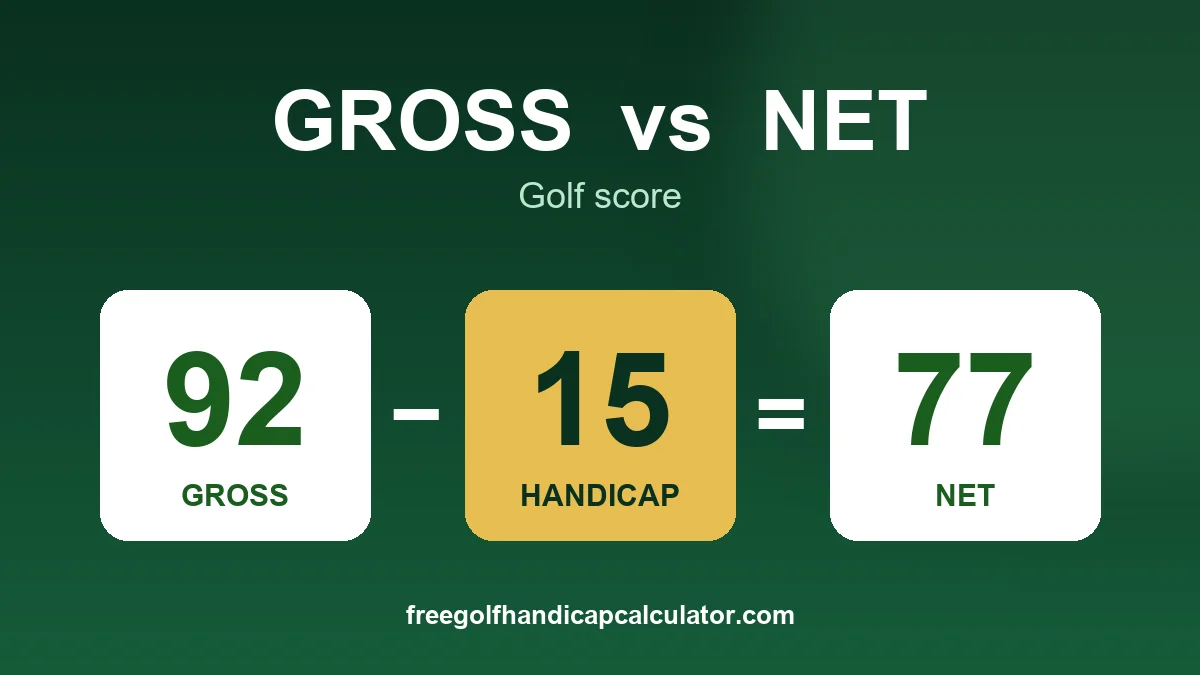
With 28 strokes you receive one stroke on every hole and a second stroke on the ten holes with stroke index 1 to 10. A gross 100 then becomes a net 72, which is net par. Our course handicap calculator does the first step for any set of tees.
Your Maximum Score Per Hole for Handicap Purposes
When you post a score, no hole counts for more than net double bogey: par + 2 + the strokes you receive on that hole, based on your Course Handicap. With a Course Handicap of 29, you receive two strokes on the holes with stroke index 1 to 11 and one stroke on the rest. On a par 4 with stroke index 5, the most that can count is 4 + 2 + 2 = 8. On a par 4 with stroke index 15, it is 4 + 2 + 1 = 7.
So a 10 on one hole does not wreck your handicap: it is recorded as net double bogey. This is one reason golfers in the 100 range should always post their scores, even on a bad day.
If 100 Is Your Best Round, Not Your Usual One
The chart assumes 100 is a score you post regularly. If 100 is your best round so far, your index will be higher, often closer to 28 to 30, because your other scores pull up the average of your best 8. If 100 is a bad day and you usually shoot in the mid-90s, your index will be nearer 20. A handicap is built from a spread of rounds, never from one.
How to Get a Handicap If You Shoot 100
You do not need to be a good golfer to have a handicap. Under the World Handicap System you can get a Handicap Index once you have posted 54 holes of scores, for example three 18-hole rounds, and the maximum Handicap Index is 54.0 for both men and women. An official index has to come from a golf club or national association; our calculators use the same maths so you know your number in the meantime.
Frequently Asked Questions
What handicap is a golfer who shoots 100?
On a par-72 course with a Course Rating of 72.0 and a Slope of 113, a golfer who regularly shoots 100 has a Handicap Index of roughly 23 to 26, most often close to 25. On an easier course the same score gives a higher index, and on a harder course a lower one.
Is breaking 100 good for a beginner?
Yes. Breaking 100 is the first big milestone in golf, and only about half of all golfers do it regularly. Golfers who keep a handicap break 100 far more often.
How many strokes over par is a score of 100?
On a par-72 course, 100 is 28 over par. That is the same as ten double bogeys and eight bogeys, although most rounds of 100 mix bogeys and pars with a few very high holes.
What is the difference between shooting 90 and 100 in handicap terms?
About ten strokes of Handicap Index. Regularly shooting 90 on a standard course gives an index of around 13 to 16; regularly shooting 100 gives around 23 to 26.
Can I get a handicap if I shoot over 100?
Yes. The maximum Handicap Index is 54.0, so golfers who shoot well over 100 can still get an official handicap once they have posted 54 holes of scores.
Why is my handicap lower than my average score minus par?
Because your Handicap Index uses only your best 8 Score Differentials from your last 20 rounds. It measures your potential, so it usually sits a few strokes below what your average score alone would suggest.
How do I convert my score of 100 into a handicap?
Work out the Score Differential for each round with (score − Course Rating) × 113 ÷ Slope Rating, then average the lowest 8 of your last 20. With only one round you cannot get a Handicap Index; you need at least 54 holes.