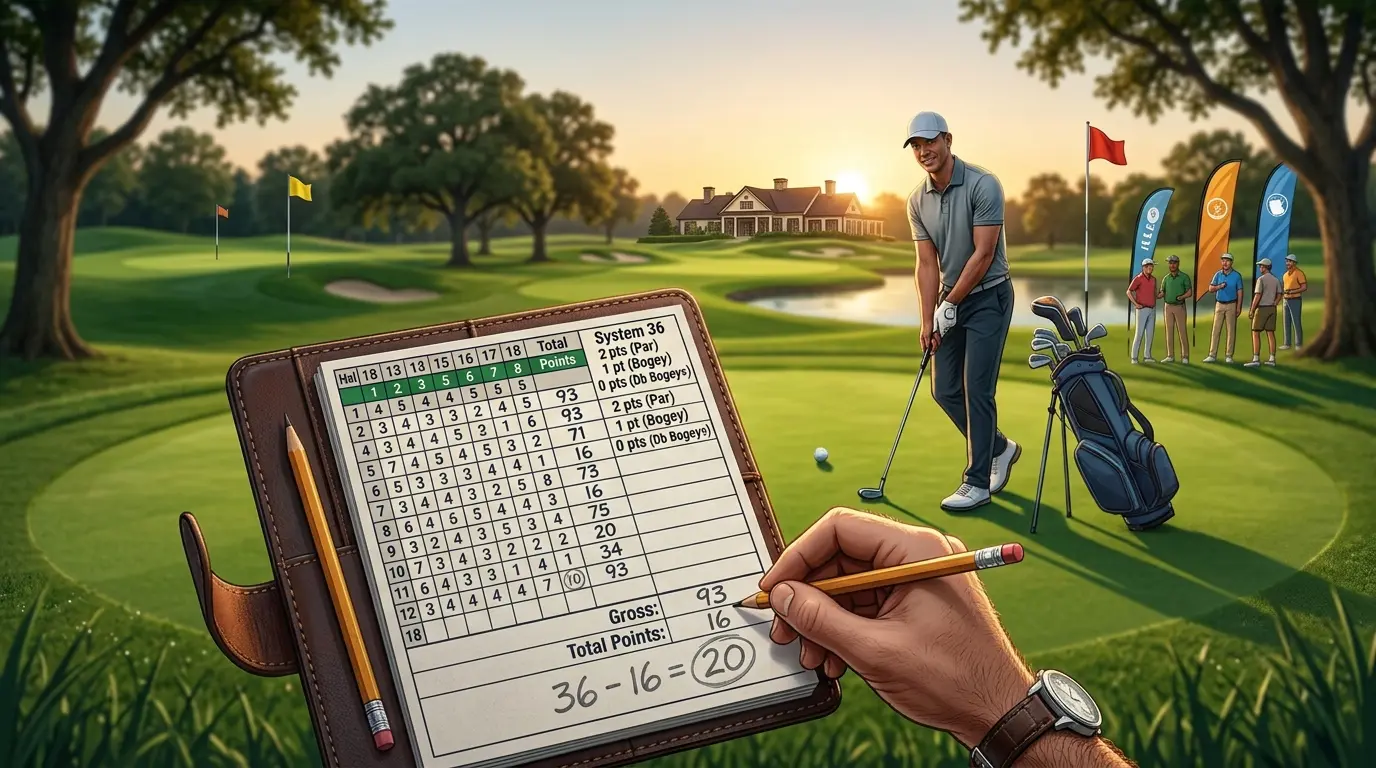
The stroke index (SI) is the number from 1 to 18 printed against each hole on a scorecard. It tells you on which holes you receive your handicap strokes: the first stroke goes on the hole with stroke index 1, the second on stroke index 2, and so on. On many American scorecards the same row is labelled “Handicap” or “HCP”.
This guide explains how strokes are handed out, why stroke index 1 is not always the hardest hole, how courses set their stroke index under the World Handicap System, and how it works in Stableford, match play and 9-hole rounds.
What Is Stroke Index in Golf?
Your Playing Handicap tells you how many strokes you receive in a round. The stroke index tells you where they go. Each hole has a different number from 1 to 18, and strokes are given out in that order. A player who receives 5 strokes gets one on each of the holes with stroke index 1, 2, 3, 4 and 5, and plays the other 13 holes off scratch.
That matters for every format that is scored hole by hole: your net score on each hole, your Stableford points and the holes where you get a shot in a net match all depend on the stroke index. If you only play stroke play and add up your total, the stroke index has no effect on your final net score, because all your strokes are taken off anyway.
Some courses print a separate stroke index for different sets of tees, or for men and women. Always use the stroke index for the tees you are actually playing.
How Stroke Index Allocates Your Handicap Strokes
Strokes are given out in stroke index order, starting again at stroke index 1 once every hole has received one:
| Playing Handicap | Strokes received |
|---|---|
| 5 | 1 stroke on SI 1 to 5, none on the other 13 holes |
| 12 | 1 stroke on SI 1 to 12, none on SI 13 to 18 |
| 18 | 1 stroke on every hole |
| 22 | 2 strokes on SI 1 to 4, 1 stroke on SI 5 to 18 |
| 30 | 2 strokes on SI 1 to 12, 1 stroke on SI 13 to 18 |
| 36 | 2 strokes on every hole |
| 40 | 3 strokes on SI 1 to 4, 2 strokes on SI 5 to 18 |
The rule behind the table: divide your Playing Handicap by 18. The whole number is how many strokes you get on every hole, and the remainder is how many holes, counting up from stroke index 1, get one extra. For 22 that is 1 on every hole plus 1 extra on SI 1 to 4. Our Stableford handicap calculator shows the strokes on each hole for you.
Is Stroke Index 1 the Hardest Hole?
Not necessarily. Stroke index 1 is the hole where the first stroke is given, which usually means it is one of the hardest holes relative to par for a higher-handicap player. But it does not have to be the hole with the highest average score, and it is often not the longest hole.
Two things explain the difference. First, difficulty is measured against par: a long par 3 that most golfers bogey can rank higher than a par 5 that is reachable. Second, the WHS guidance on spreading strokes around the course can move a hole up or down the order, for example to keep low stroke indexes away from the first and last holes of each nine.
How Courses Set the Stroke Index (WHS Appendix E)
Under the World Handicap System, the stroke index is set by the club’s committee. Appendix E of the Rules of Handicapping gives a recommended method; it is guidance, not a strict requirement, so you will find famous courses that do it differently.
- Difficulty of each hole: holes are ranked by how hard they play relative to par. The recommended measure uses Course Rating data: the hole’s scratch value plus its bogey value, minus twice the par. On a par 4 with a scratch value of 4.2 and a bogey value of 5.3, that is 4.2 + 5.3 − 8 = 1.5 strokes over par.
- Odd and even nines: odd stroke indexes (1, 3, 5…) normally go on the front nine and even ones (2, 4, 6…) on the back nine. If the back nine is clearly harder, the committee can switch them.
- Low indexes in the middle: each nine is split into three groups of three holes. Stroke index 1 or 2 goes in the middle group of its nine, so players receiving few strokes get them early enough to matter.
- Spread them out: where possible, low stroke indexes (6 or lower) should not fall on consecutive holes, so a player’s strokes are not used up in one short stretch.
You can read the full text in Appendix E of the Rules of Handicapping on the R&A website.
Worked Example: One Hole, Three Golfers
A par-4 hole with stroke index 3. Three golfers each take a gross 6.
| Golfer | Playing Handicap | Strokes on SI 3 | Net score | Stableford points |
|---|---|---|---|---|
| Amy | 2 | 0 | 6 (net double bogey) | 0 |
| Ben | 10 | 1 | 5 (net bogey) | 1 |
| Cara | 22 | 2 | 4 (net par) | 2 |
Amy receives only 2 strokes, on SI 1 and 2, so none here. Ben receives one on SI 1 to 10, and Cara receives two on SI 1 to 4. Same gross score, three different net results. For the full scoring rules, see our Stableford calculator and our guide to gross vs net scores.
Plus Handicaps: Giving Strokes Back
A player with a plus handicap gives strokes back instead of receiving them. Unless the committee says otherwise, those strokes are given back starting with stroke index 18, the hole where strokes are given last. A +2 player adds a stroke on the holes with stroke index 18 and 17.
Stroke Index in Match Play
In a singles net match, the player with the lower Playing Handicap plays off scratch and the other player receives the difference, on the holes with the lowest stroke index. If Player A has a Playing Handicap of 8 and Player B has 15, Player B receives 7 strokes, one on each hole with SI 1 to 7. Our guide to match play handicap allowances covers the percentages for each format.
The USGA notes that in match play the exact order of the stroke indexes matters less than spreading them sensibly: avoiding low indexes on consecutive holes and at the start or end of each nine gives the player receiving strokes a fair chance to use them before the match is decided.
Stroke Index in 9-Hole Rounds
When you play nine holes of an 18-hole course, you take your strokes in ascending order of the published 18-hole stroke index on that nine, unless the committee has published a separate 1-to-9 allocation. On a front nine with the odd stroke indexes 1, 3, 5 … 17, a player who receives 5 strokes gets them on the holes with SI 1, 3, 5, 7 and 9. Our 9-hole handicap calculator works out how many strokes you receive.
Stroke Index and Net Double Bogey
The stroke index also decides your maximum score on each hole for handicap purposes. Net double bogey is par + 2 + the strokes you receive on that hole. With 2 strokes on a par-4 hole, the most that can count is 4 + 2 + 2 = 8; with no stroke on that hole, it is 6. Your Course Handicap and the stroke index together set this limit hole by hole.
Frequently Asked Questions
What does stroke index mean in golf?
The stroke index is the number from 1 to 18 on the scorecard that sets the order in which handicap strokes are given. The first stroke goes on stroke index 1, the second on stroke index 2, and so on.
Is stroke index 1 the hardest hole on the course?
Usually it is one of the hardest holes relative to par, but not always the hardest. The ranking is based on difficulty against par, and it is then adjusted to spread strokes evenly around the course.
Where do I get strokes if my handicap is over 18?
You get one stroke on every hole plus a second stroke on the holes with the lowest stroke index. With a Playing Handicap of 22, you get two strokes on SI 1 to 4 and one on every other hole.
What is the difference between stroke index and handicap on a scorecard?
On many scorecards they are the same thing. American cards often label the stroke index row “Handicap” or “HCP”; it is not your personal handicap but the order in which strokes are given on that course.
Does stroke index matter in stroke play?
Not for your total net score, because all your strokes are deducted at the end. It does matter for your net score on each hole, for net double bogey when you post your score, and for Stableford and match play.
How do plus handicaps use the stroke index?
A plus-handicap player gives strokes back, starting on stroke index 18 unless the committee decides otherwise. A +3 player adds a stroke on SI 18, 17 and 16.
Who decides the stroke index of a course?
The club’s committee, following the recommendations in Appendix E of the Rules of Handicapping. The guidance covers ranking holes by difficulty against par, odd and even indexes on each nine and spreading low indexes around the course.