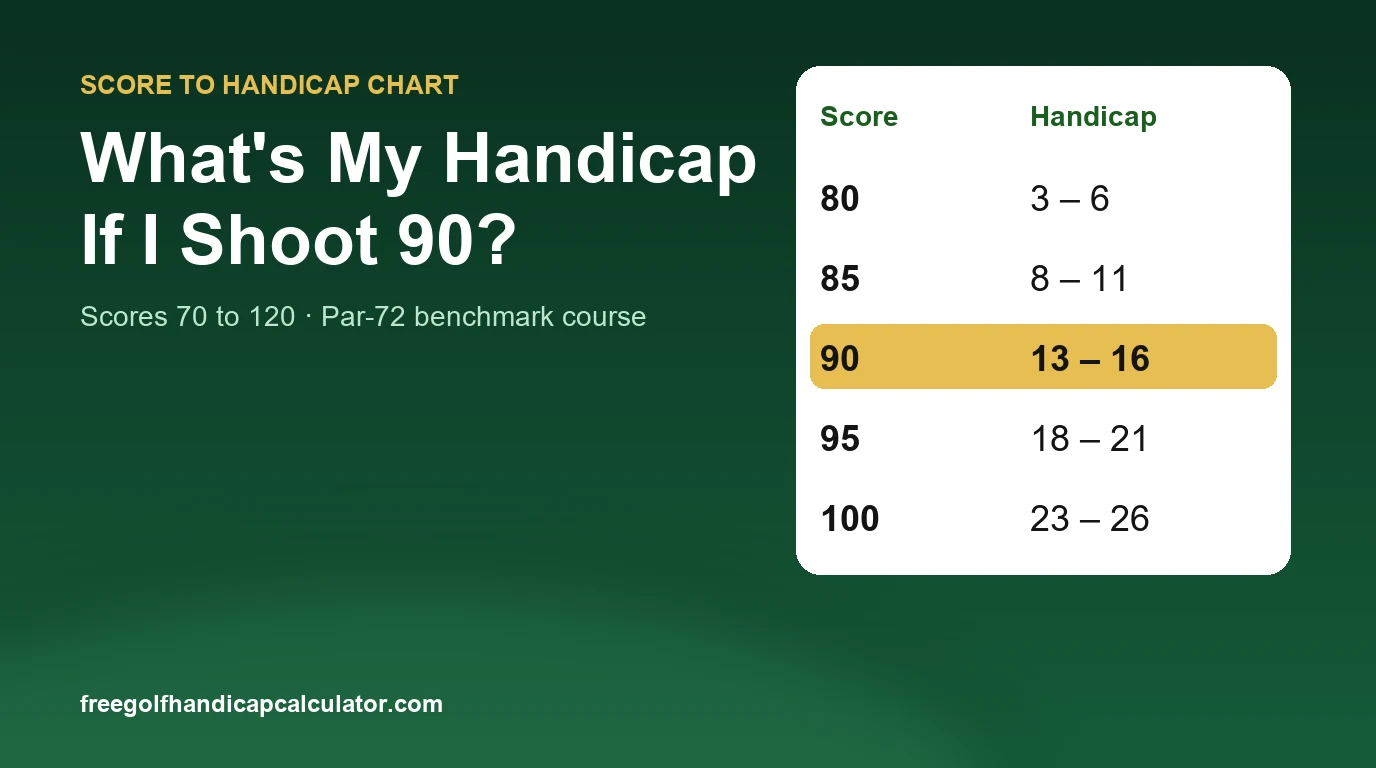
If you shoot around 90 on a par-72 course, your Handicap Index is usually somewhere between 13 and 16. Most golfers who consistently card 90 end up close to 15.
That is the short answer. The longer one matters, because two golfers who both shoot 90 can carry handicaps four or five strokes apart, and the reason has nothing to do with how well either of them plays.
Score to Handicap Chart
This chart assumes a par-72 course with a Course Rating of 72.0 and a Slope Rating of 113 — the benchmark the whole system is built around. On that course the Score Differential is simply your score minus 72.
| Typical score | Score Differential | Handicap Index | Where that puts you |
|---|---|---|---|
| 75 | 3.0 | 0 – 1 | Scratch or close to it |
| 80 | 8.0 | 3 – 6 | Low single figures |
| 85 | 13.0 | 8 – 11 | Strong club golfer |
| 90 | 18.0 | 13 – 16 | Solid mid-handicapper |
| 95 | 23.0 | 18 – 21 | Mid to high handicap |
| 100 | 28.0 | 23 – 26 | High handicap |
| 105 | 33.0 | 28 – 31 | Improving beginner |
| 110 | 38.0 | 33 – 36 | Beginner |
| 115 | 43.0 | 38 – 41 | Early days |
| 120 | 48.0 | 43 – 46 | Early days |
Notice that the Handicap Index always sits a few strokes below the differential of your typical score. That is not an error. A Handicap Index is the average of your best 8 differentials out of the last 20 rounds, not the average of all 20 — so it reflects your better golf, not your everyday golf. Across most golfers that gap runs to about three or four strokes.
Why Two Golfers Who Both Shoot 90 Can Have Different Handicaps
A score on its own means nothing until you know where it was shot. Ninety on a short municipal course and ninety from the back tees of a championship layout are two completely different rounds, and the handicap system is built to tell them apart.
Every set of tees carries a Course Rating and a Slope Rating. The Course Rating is what a scratch golfer is expected to shoot; the Slope describes how much harder the course plays for an ordinary golfer. Your Score Differential for a round is:
Score Differential = (Adjusted Gross Score − Course Rating) × 113 / Slope Rating
Shoot 90 on a course rated 72.0 with a Slope of 113 and the differential is 18.0. Shoot the same 90 on a harder course — rating 74.5, Slope 135 — and the differential is 13.0, a full five strokes better. Same score, same golfer, very different contribution to the handicap.
This is why any chart, including the one above, is an estimate. The only way to know your number is to run your actual rounds through the Handicap Index calculator with the correct rating and slope for the tees you played.
What Handicap Is Each Score?
Shooting 80
A regular 80 puts you around a 3 to 6 handicap — low single figures, and better than the large majority of golfers who ever post a score. At this level your handicap moves slowly, because the best 8 of your 20 rounds are already tightly bunched.
Shooting 85
Around 8 to 11. This is the range where a golfer stops having blow-up holes and starts losing strokes in smaller, more stubborn ways — a missed green here, a three-putt there.
Shooting 90
13 to 16, usually settling near 15. Breaking 90 is the milestone most club golfers measure themselves by, and a golfer who does it consistently is playing better than roughly three quarters of all golfers, although among golfers who keep a handicap the share is closer to half.
Shooting 95
Around 18 to 21. Typically one or two holes a round are costing four or five shots each. Removing those, rather than improving everything at once, is what moves this number fastest.
Shooting 100
23 to 26. Breaking 100 is the first real milestone in golf, and a golfer sitting just above it is usually closer to crossing it than they think — often a single hole per round separates 100 from 97. For the full breakdown, see what’s my handicap if I shoot 100.
Shooting 110
Around 33 to 36. Under the World Handicap System the maximum index is 54.0, so a beginner scoring well above 110 still has a legitimate handicap and can play in competitions from day one.
How Many Golfers Actually Break 90?
Fewer than most people assume. Figures commonly quoted from the National Golf Foundation, which cover golfers in general rather than only those with a handicap, point to roughly this spread:
| Milestone | Share of golfers who manage it |
|---|---|
| Break 100 | about half |
| Break 90 | about one in four |
| Break 80 | roughly one in twenty |
| Break 70 | very rare |
These are approximations for golfers in general, and surveys define “breaking 90” differently (regularly, on average or at least once). Golfers who keep a handicap play more often and score better: about half of men with a USGA Handicap Index are below 14, roughly the level of a golfer who shoots 90, so among handicap holders breaking 90 regularly is closer to one in two. Either way, if you shoot 90, you are playing better golf than most of the people on the course.
If 90 Is Your Best Round, Not Your Usual One
The chart above assumes 90 is a score you post regularly. If it is the best round you have ever played, the answer changes: your index would sit closer to 18, because the rest of your scores pull the average of your best 8 upward.
It works the other way too. If 90 is a bad day and you usually card in the mid-80s, your index will be nearer 10 than 15. Handicaps are built from a spread of rounds, never from one.
How to Work Out Your Real Handicap
A chart gives you an estimate in ten seconds. Your actual Handicap Index needs your own scores and the ratings of the courses you played:
- Enter your rounds in the Handicap Index calculator — it takes the best 8 of your last 20 automatically.
- Work out a single round’s Score Differential if you only want to check one card.
- Convert the result to the strokes you actually receive with the Course Handicap calculator.
- Find the rating figures your course uses with the Course Rating and Slope calculator.
One caveat worth stating plainly: a calculated index is not an official Handicap Index. Only an authorised golf club or national association can issue one. What these tools give you is the same arithmetic, so you know where you stand before you join.
Frequently Asked Questions
What handicap is a golfer who shoots 90?
On a par-72 course rated 72.0 with a Slope of 113, a golfer who regularly shoots 90 carries a Handicap Index of roughly 13 to 16, most often near 15. On an easier course the same score produces a lower index; on a harder one, a higher index.
Is shooting 90 good in golf?
Yes. Only about a quarter of all golfers break 90 regularly. Among golfers who keep a handicap the share is closer to half, because they tend to play more often, but shooting 90 still puts you comfortably in the better half of everyone on the course.
How do I convert my golf score to a handicap?
Take the Score Differential for each round — (score − Course Rating) × 113 / Slope Rating — then average the lowest 8 of your last 20 differentials. That average is your Handicap Index. A single score cannot produce a handicap on its own.
Why is my handicap lower than my average score suggests?
Because a Handicap Index uses only your best 8 rounds out of the last 20, not all of them. It measures your demonstrated potential rather than your typical day, and that usually leaves it three or four strokes below what your average score alone would imply.
How many rounds do I need before I have a handicap?
Under the World Handicap System you can get an index after posting 54 holes, which is three 18-hole rounds or any combination of 9 and 18-hole cards adding up to 54. The index becomes steadier once you have 20 rounds on record.
What is the highest handicap allowed?
54.0 for both men and women under the World Handicap System. That ceiling exists deliberately, so beginners can hold a handicap and enter competitions rather than waiting until they are good enough to qualify.