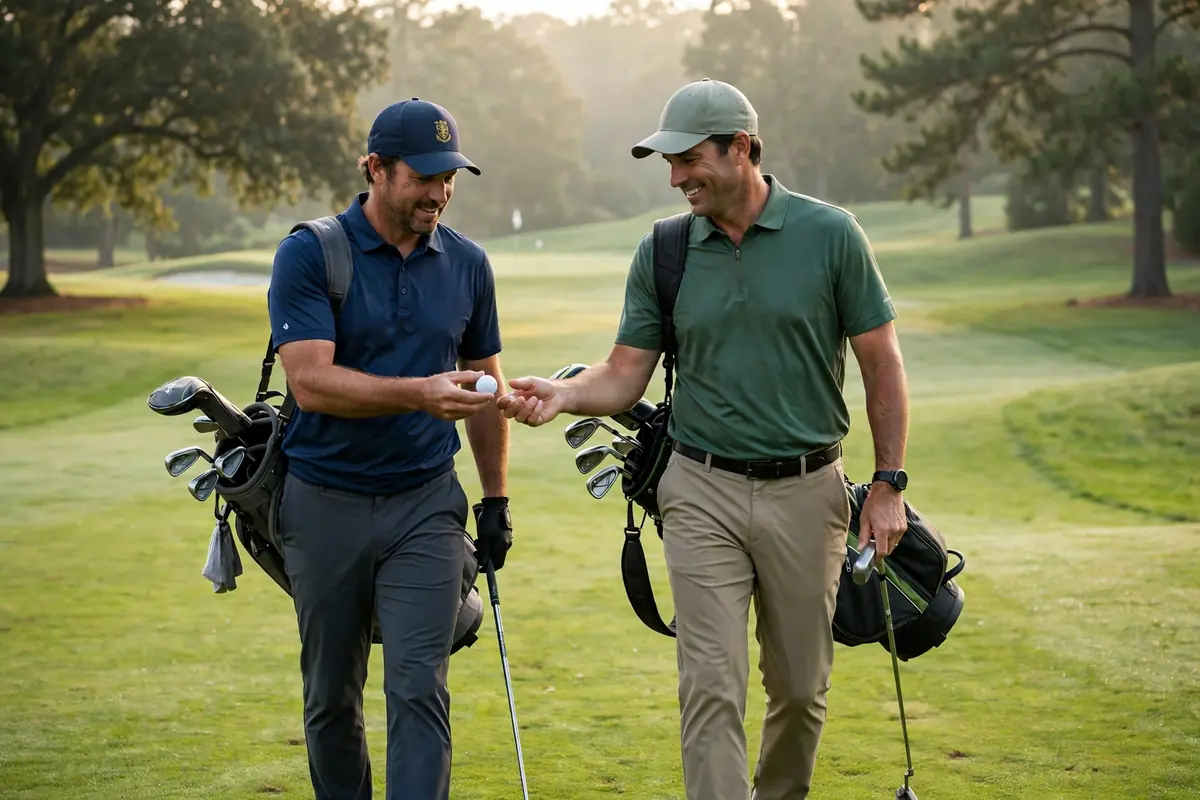
Imagine a team format where you get to hit your partner’s drive — and they get to hit yours. Where one great tee shot isn’t enough, because the hole is really decided by the second shots. And where husbands and wives, scratch players and 20-handicappers, can form genuinely competitive teams.
That’s the Chapman System — also called Pinehurst or American Foursomes. It’s one of the cleverest 2-person team formats in golf, it’s recognized in the official handicap allowance tables (unlike most casual formats), and it’s underused at club level. Let’s fix that.
What Is the Chapman Format in Golf?
The format was invented by Dick Chapman — the great American amateur who played in 19 Masters Tournaments, a record for an amateur — at Pinehurst Resort in North Carolina. That’s why it carries both names: the Chapman System after its inventor, and Pinehurst after its birthplace. (It’s also occasionally called “American Foursomes,” which tells you roughly where it sits in the team-format family.)
The concept is simple and brilliant. On every hole:
- Both partners tee off — each plays their own drive.
- Partners switch balls — each player plays their partner’s ball for the second shot.
- The team selects the best second shot — of the two balls now in play, they pick one.
- Alternate shot from there — the team plays that single ball into the hole, alternating strokes until it’s holed out.
One team score per hole. Two players, one ball after the second shot, constant collaboration. Unlike a scramble (best shot every time) or best ball (everyone plays their own ball), Chapman forces both partners to contribute on every hole — you literally play each other’s shots.
Chapman Rules: How to Play It Step-by-Step
Before the round:
- Form 2-person teams. Chapman is strictly a pairs format (2-vs-2 matches or a field of pairs in stroke play).
- Decide stroke play or match play. Chapman works beautifully as either.
- Calculate team handicaps using the official allowance (see below) — one of Chapman’s big advantages is that the math is standardized.
On each hole:
- Both partners tee off. Player A hits their drive; Player B hits theirs. Normal Rules of Golf apply — this is real golf, not a scramble.
- Switch balls for the second shot. Player A now plays Player B’s ball, and Player B plays Player A’s ball. Each player hits one second shot — with their partner’s ball.
- Select the best second shot. The team compares the two resulting positions and chooses one ball to continue with. The other ball is lifted.
- Alternate shot to finish. From the third stroke onward, partners take turns hitting the selected ball until it’s holed out. The player who did not hit the selected second shot plays the third shot — then you simply alternate.
- Record one team score for the hole.
The third-shot rule matters strategically. Because the player who didn’t hit the chosen second shot hits next, teams sometimes select the best second shot partly based on who gets the third. Example: your partner stripes the second shot to 8 feet, but you’re the far better putter — you might prefer the 25-footer if it means you get the putt. It’s a small wrinkle that rewards teams who think two shots ahead.
Chapman vs Modified Pinehurst vs Foursomes: Don’t Mix Them Up
This is where most golfers get confused, so let’s be precise:
| Chapman (Pinehurst) | Modified Pinehurst | Foursomes | Greensomes | |
|---|---|---|---|---|
| Tee shots | Both tee off | Both tee off | One tees off (alternate tees) | Both tee off |
| Second shots | Switch balls — each plays partner’s | Best drive selected first | Partner of the tee-shot player | Best drive selected; the other player hits the 2nd shot |
| From there | Best 2nd shot selected, then alternate shot | Alternate shot from the chosen drive | Alternate shot throughout | Alternate shot from the chosen drive |
| WHS allowance | 60% low + 40% high | Not in the WHS table (usually 60/40, as Greensomes) | 50% of combined | 60% low + 40% high |
The critical difference between Chapman and Modified Pinehurst: in Chapman, both drives stay alive through the second shot (because you switch and each plays the other’s ball). In Modified Pinehurst, the team picks the best drive immediately — like a shamble off the tee — and the player whose drive wasn’t chosen hits the second shot. Chapman gives both tee shots a genuine chance to matter; Modified Pinehurst is faster but less interesting.
And neither is foursomes (true alternate shot from the very first tee shot, with partners alternating who tees off). If you like the alternate-shot finish but want both players driving, Chapman is your format.
Chapman Handicap: The Official WHS Allowance
Here’s where Chapman stands apart from casual games like Wolf or Bingo Bango Bongo: it has an official, published handicap allowance. The WHS recommended allowances table — reproduced by the SCGA and National Club Golfer — lists Pinehurst/Chapman at 60% of the lower Course Handicap plus 40% of the higher Course Handicap.
The exact mechanics:
- Calculate each partner’s Course Handicap (our handicap calculator does this from Handicap Index, Slope Rating, Course Rating, and Par — the full formula is explained in our handicap calculation guide).
- Take 60% of the lower Course Handicap and 40% of the higher Course Handicap.
- **Add the two percentages together before rounding, then round the total to the nearest whole number (.5 rounds up). That total is the team playing handicap**.
In stroke play: subtract the team handicap from the team’s gross score for the net score.
In match play: both sides compute their team allowance the same way. The side with the lower allowance plays off scratch; the side with the higher allowance receives the difference, applied on the hardest holes by stroke index.
Worked handicap example
Team 1: Dan (Course Handicap 6) and Eva (Course Handicap 18).
Team allowance = (0.60 × 6) + (0.40 × 18) = 3.6 + 7.2 = 10.8 → 11.
Team 2: Fred (Course Handicap 10) and Gina (Course Handicap 14).
Team allowance = (0.60 × 10) + (0.40 × 14) = 6.0 + 5.6 = 11.6 → 12.
- Stroke play: Team 1 deducts 11 from their gross; Team 2 deducts 12.
- Match play: Team 1 (11) plays off scratch; Team 2 (12) receives 1 stroke, applied on the stroke-index-1 hole.
Notice the design: weighting the lower handicap at 60% keeps strong players meaningful, while the 40% for the higher handicap keeps weaker partners relevant. A scratch-plus-20-handicap pairing gets a genuinely competitive number — which is exactly why Chapman is a favorite for mixed-ability and couples’ events.
Worked Example: A Chapman Hole, Shot by Shot
A par 4, 380 yards. Team: Dan (CH 6) and Eva (CH 18), playing stroke play.
- Tee shots: Dan stripes his drive 250 yards down the middle. Eva’s drive leaks right into the rough, 190 yards out.
- The switch: Dan now plays Eva’s ball from the rough; Eva plays Dan’s ball from the fairway.
- Second shots: Dan hacks Eva’s ball out of the rough to 60 yards short of the green. Eva, from Dan’s perfect drive, hits a lovely approach to 10 feet.
- Selection: The team obviously takes Eva’s ball (10 feet for birdie). Dan’s ball from the rough is lifted.
- Alternate shot: Eva hit the selected second shot, so Dan putts third — he lips it out. Eva taps in for 4. Team score: 4.
Now the strategic wrinkle in action: suppose Eva’s approach had finished 25 feet away while Dan is the far better putter. The team would at least discuss it, because taking Eva’s ball means Dan (the better putter) putts. In Chapman, the second-shot selection is never just about distance to the hole; it’s about who hits next.
Over 18 holes, the team records one gross score per hole, subtracts their team handicap (11 for Dan and Eva), and that’s their net total.
Chapman Strategy Tips
- Drive for position, not just distance. Since your partner has to play your drive for the second shot, a 230-yard drive in the fairway is worth more than a 270-yard drive in the trees. Think about what they want to hit, not what looks heroic.
- Know each other’s games. The switch means you’ll regularly play shots from your partner’s typical misses. Talk on the tee: “If I miss, it’ll be right — aim me left.”
- Think two shots ahead on the selection. The best second shot isn’t always the closest to the hole — it’s the one that sets up the right player for the third. Factor in who’s putting or chipping next.
- Play to your partner’s strengths in the alternate-shot phase. If one of you putts better and the other chips better, your selections should quietly steer the third shot toward the right skill.
- On par 3s, be extra careful. A par 3 offers no recovery margin — both tee shots must be sensible, because your partner is hitting the second from wherever you put it.
- Use the handicap math when forming teams. A low-plus-high pairing is genuinely competitive under 60/40 — don’t assume two mid-handicappers automatically beat a scratch-plus-beginner team. Run the numbers on our handicap calculator before you concede anything.
- Practice the switch. Most golfers have never played their partner’s ball. A few practice holes of “you hit mine, I hit yours” before the event pays off enormously.
Can You Post a Chapman Score for Handicap?
Not as an individual score. In Chapman you don’t play your own ball for the round — you play your partner’s ball on the second shot and alternate shot thereafter — so the round can’t produce an acceptable individual score under WHS principles. The same applies to foursomes and other alternate-shot formats. But Chapman is a formally recognized team format with a published allowance — you just need your own current Course Handicap, which our handicap calculator provides.
Frequently Asked Questions
What is the Chapman format in golf?
A 2-person team format where both partners tee off, then switch balls for the second shot (each plays the other’s drive). The team selects the best second shot and plays alternate shot from there until holed out. Also called the Pinehurst System or American Foursomes.
Who invented the Chapman System?
Dick Chapman, the American amateur star who played in 19 Masters Tournaments, a record for an amateur, devised it at Pinehurst Resort in North Carolina — hence the alternate name “Pinehurst.”
What is the difference between Chapman and Pinehurst?
Nothing — they’re two names for the same format. “Chapman” honors the inventor; “Pinehurst” honors the resort where it was created.
What is the difference between Chapman and Modified Pinehurst?
In Chapman, both drives stay alive: partners switch balls and each plays the other’s drive for the second shot, then the best second shot is selected. In Modified Pinehurst, the team picks the best drive immediately and alternate-shots from there — no ball switch.
What is the handicap allowance for Chapman?
The WHS recommended allowance is 60% of the lower partner’s Course Handicap plus 40% of the higher partner’s Course Handicap, added together before rounding. Example: CH 6 + CH 18 → (0.6×6) + (0.4×18) = 10.8 → team handicap 11.
How does Chapman work in match play?
Both sides compute their team allowance (60/40). The side with the lower allowance plays off scratch; the higher side receives the difference in strokes, applied on the hardest holes by stroke index.
How many players do you need for Chapman?
Four — two 2-person teams playing a match — is classic, but any number of pairs can play stroke play in a field. It’s strictly a pairs format.
Is Chapman good for beginners?
Yes — it’s one of the best team formats for mixed abilities. The official 60/40 handicap allowance keeps low-plus-high pairings competitive, both partners contribute on every hole, and the alternate-shot finish takes pressure off the weaker player’s short game.