If you have just started playing golf, you have likely heard other players discussing their handicap. A golf handicap for beginners is simply a numerical measure of your potential ability on the golf course. It allows you, as a new player, to compete fairly against highly experienced golfers by adjusting the final scores based on each player’s skill level. Under the official World Handicap System (WHS), beginners typically start with handicaps ranging between 30 and the maximum of 54.0.
When you are just getting started, golf terminology can feel incredibly intimidating. You might wonder if you are even “good enough” to need a handicap yet. The short answer is yes — establishing a handicap is one of the best things a beginner can do to track their improvement. You only need to play 54 holes (which can be any combination of 9-hole and 18-hole rounds) to establish your first official number. This guide will walk you through exactly what a handicap is in plain English, how to get your first one, and what to expect as a beginner golfer.
What Every Beginner Needs to Know About Golf Handicaps
The Handicap System in Plain English
To understand the handicap system, imagine a footrace between an Olympic sprinter and a casual jogger. Without any adjustments, the race is pointless; the Olympian will win every time. But what if we gave the jogger a 40-yard head start in a 100-yard dash? Suddenly, the race is competitive. Both athletes have to perform at their absolute best to win.
This is exactly how a golf handicap works. The system assigns a number to every golfer based on their recent scores. A highly skilled player (a scratch golfer) might have a handicap of 0. A beginner golfer might have a handicap of 36. If they play against each other, the beginner is essentially given a 36-stroke “head start” over the course of 18 holes. If both players have an average day, they will tie. This brilliant system is what makes golf unique among sports, allowing friends of wildly different abilities to play together fairly.
If you want a deeper dive into the specific definitions, you can read our foundational guide on what is a golf handicap. For now, just remember: your handicap is the number of strokes you are expected to shoot over “par” (the target score) on a course of average difficulty.
How to Get Your First Handicap
Step-by-Step: Getting Your Official Handicap
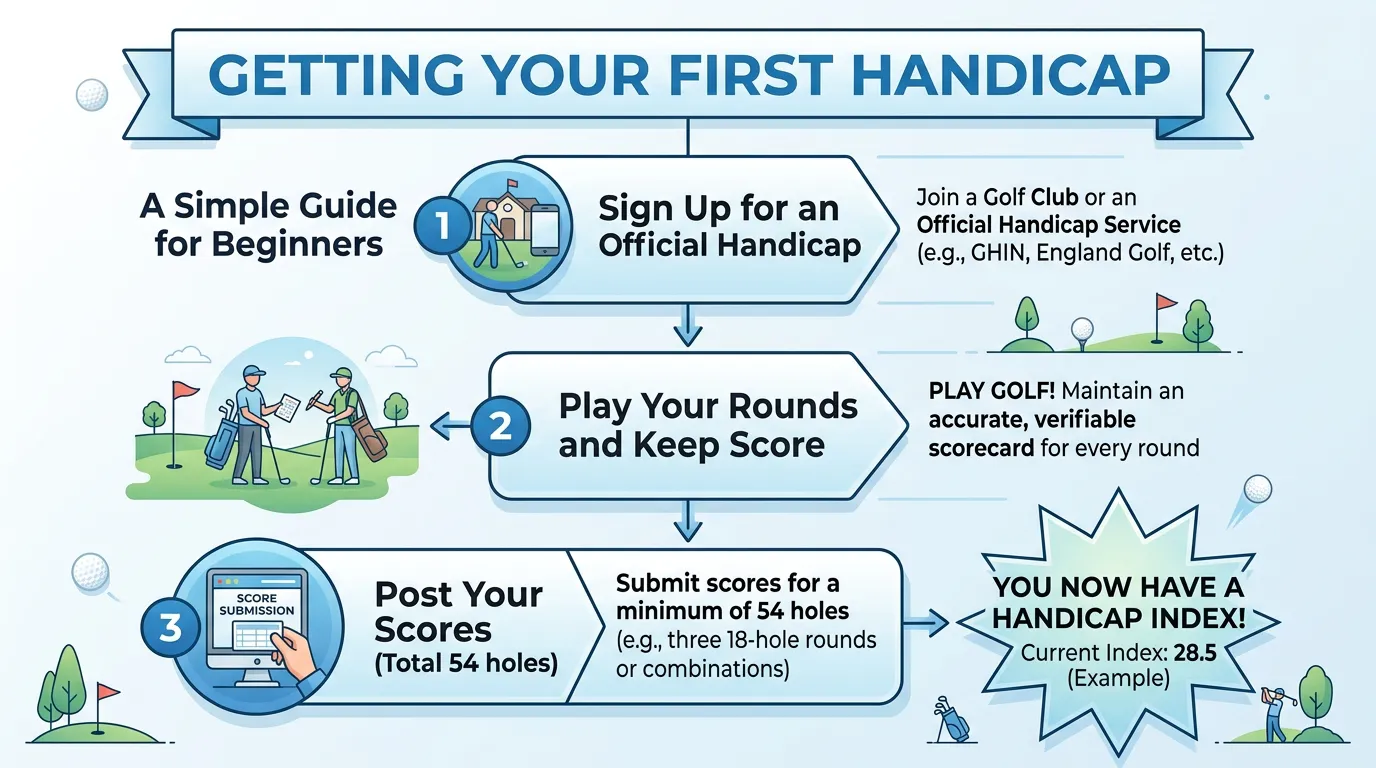
Getting your first golf handicap is a much simpler process than most beginners realize. You do not need to be a member of an expensive private country club, and you do not need to shoot particularly good scores. You simply need to follow these basic steps.
1. Sign Up for an Official Handicap: To get an official WHS handicap, you need to register through an authorized golf association. In the United States, this means joining an “Allied Golf Association” through the USGA. You can easily do this online through the USGA website, via various golf apps, or by paying a small annual fee at the pro shop of your local public golf course.
2. Play Your Rounds and Keep Score: Go out and play golf. You must play according to the basic Rules of Golf (no kicking the ball out of the woods, no taking extra “mulligan” shots without penalty). Keep an honest scorecard. You do not have to play 18 holes at once; 9-hole rounds are perfectly acceptable.
3. Post Your Scores: After your round, enter your score into the app or website provided by your golf association. Once you have posted scores totaling 54 holes (e.g., three 18-hole rounds, or six 9-hole rounds), the system will calculate your very first official Handicap Index overnight (USGA). Alternatively, you can always estimate your progress using our free handicap calculator.
Understanding Your Initial Handicap
Why Your First Handicap Might Not Be Accurate Yet
When you receive your first official handicap, you might be surprised by the number. It is crucial to understand that your initial handicap is based on a very small sample size (just 54 holes). Therefore, it may not perfectly represent your true potential right out of the gate.
The handicap system uses a specific calculation based on a concept called a “score differential,” which takes into account the difficulty of the golf course you played. As you post more scores, the system becomes more accurate. Once you have posted 20 scores, your handicap is calculated using only your best 8 rounds out of those 20. This is why your handicap represents your *potential* on a good day, not your overall average.
If you have recently taken a golf lesson and are implementing swing changes, your scores might fluctuate wildly. Do not panic if your first handicap is high. The system is designed to adjust quickly as your game improves, rewarding you as you break through those early beginner milestones.
What to Expect as a Beginner Golfer
Typical Beginner Handicap Ranges
A common source of anxiety for new players is comparing themselves to experienced golfers. It is vital to set realistic expectations. According to the rules of the World Handicap System, the maximum allowable handicap for any golfer — male or female — is 54.0.
Most true beginners, when they first establish their handicap, will find their number falls somewhere between 30 and 54. This means they are typically shooting between 105 and 130 on a standard 18-hole golf course. If you are in this range, you are exactly where you should be as a new golfer.
As you gain experience, perhaps buy your first fitted set of golf clubs, and learn basic course management, you will see your handicap drop. Most beginners who practice regularly can expect to see a 5 to 10 stroke improvement in their handicap during their first active year of playing. If you want to understand the math behind these changes, you can read about how to calculate your golf handicap.
Beginner-Friendly Handicap Tracking Tools
Apps and Tools for New Golfers
You do not need to do any complex math to maintain your handicap. The modern golfing ecosystem is filled with beginner-friendly tools that do all the heavy lifting for you.
If you register for an official handicap in the United States, you will likely use the GHIN (Golf Handicap and Information Network) mobile app. It allows you to search for the golf course you are playing, enter your gross score (your total number of strokes), and automatically posts it to your record.
There are also numerous third-party apps available in the app store that offer GPS distances, stat tracking, and unofficial handicap estimates. These are fantastic tools for beginners who want to track their progress before committing to an official USGA handicap. Tracking your stats — like how many fairways you hit or how many putts you take — is one of the fastest ways to figure out exactly what you need to practice to lower your score and eventually reach what constitutes a good handicap.
Common Mistakes Beginners Make with Handicaps
Score Posting Errors to Avoid
When beginners start posting scores, they frequently make a few common mistakes that can artificially inflate or deflate their handicap. Understanding these pitfalls early will ensure your handicap is accurate and fair.
1. Not Posting Bad Scores: Many beginners think they should only post their “good” rounds. This is entirely incorrect. The handicap system requires you to post every acceptable round you play, good or bad. Because the formula eventually only counts your best 8 of your last 20 scores, a terrible round will naturally be filtered out, but the system needs all the data to work properly.
2. Misunderstanding Net Double Bogey: You do not have to write down a “12” on your scorecard if you hit three balls in the water. The WHS utilizes a maximum hole score limit known as “Net Double Bogey” for handicap purposes. This rule prevents one disastrous hole from ruining your entire handicap calculation. As a beginner with a high handicap, this rule is your best friend.
3. Playing “Practice” Rounds: If you step onto the first tee with the intention of playing a real round of golf according to the rules, you must post the score. You cannot decide on the 14th hole, after a bad drive, that it is suddenly a “practice round.”
New to scoring? Our guide on how to keep score in golf explains every box on the card, from par and stroke index to Stableford points, and includes a free printable scorecard.
Frequently Asked Questions
Can a beginner get a handicap?
Yes, absolutely. In fact, the handicap system is designed specifically so beginners can track their progress and play fairly against more experienced players. You only need to play a total of 54 holes (which can be six 9-hole rounds) to establish your first official handicap.
Do I need a handicap to play golf?
No. Millions of casual golfers play the game entirely for fun without ever keeping an official handicap. However, if you want to play in amateur tournaments, compete in a local league, or play a formal match for stakes with friends, you will need an official handicap.
How many rounds to get a handicap?
Under the World Handicap System, you need scores from a minimum of 54 holes. This is usually accomplished by playing three 18-hole rounds, but any combination of 9-hole and 18-hole rounds that adds up to 54 will trigger the system to issue your first Handicap Index.
How long does it take to get a golf handicap?
It takes as little time as it takes you to play 54 holes. If you play three 18-hole rounds over a single weekend and post your scores, your handicap will be calculated during the overnight revision, and you will have an official handicap by Monday morning.
What is a good handicap for a beginner?
For a true beginner, simply establishing a handicap is a success. Initially, a beginner’s handicap will likely be between 30 and the maximum of 54. Breaking 100 consistently and getting your handicap down to the high 20s (e.g., a 28 handicap) is a fantastic and realistic goal for your first year of playing.
Conclusion
Getting your first golf handicap is an exciting milestone in your golfing journey. It represents a transition from simply hitting a ball around a park to truly engaging with the sport of golf. By establishing a handicap, you give yourself a baseline — a tangible, mathematical starting point from which you can measure every future improvement.
Do not be intimidated by the numbers or the terminology. Join a local association, play your 54 holes, and start posting your scores. Whether your first handicap is a 30 or a 50, it is yours. Embrace it, practice with purpose, and enjoy the satisfaction of watching that number drop as your skills grow.