
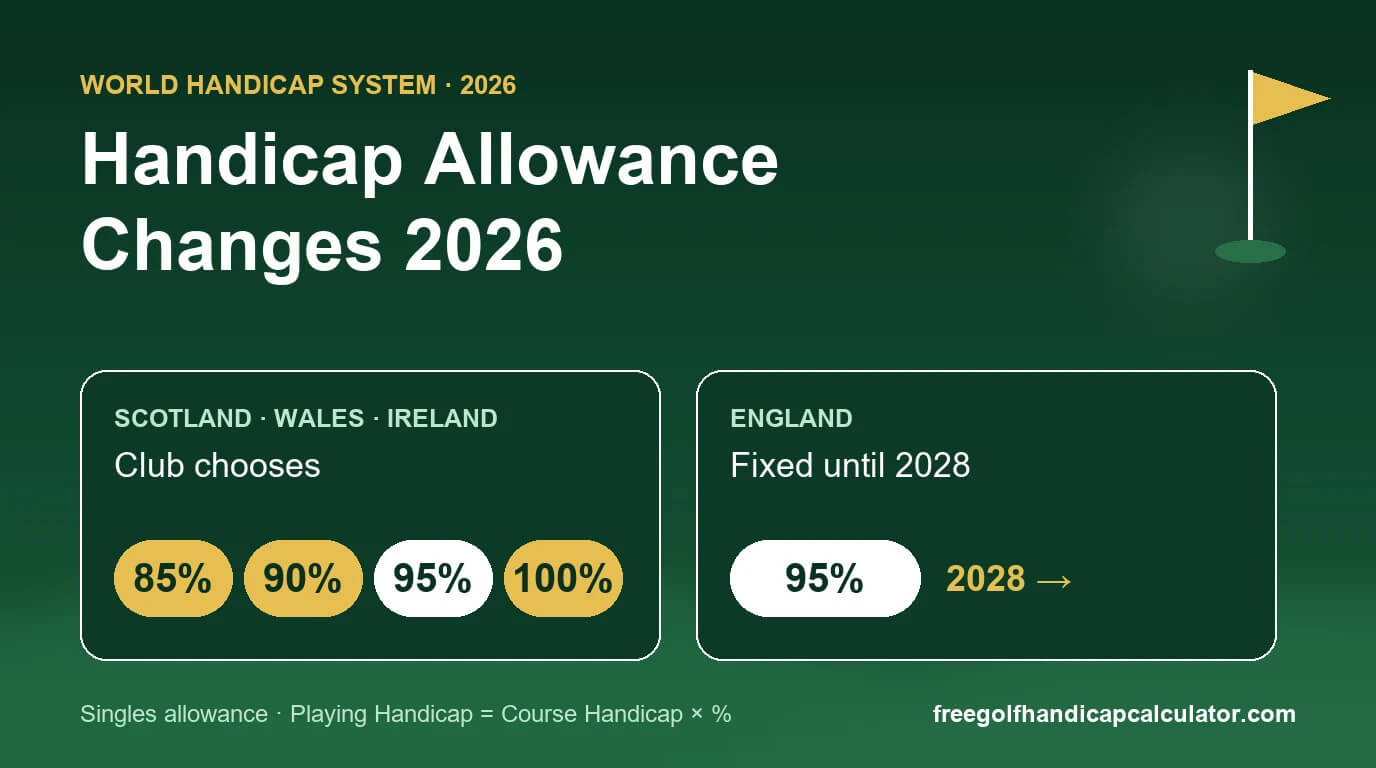
Since 1 April 2026, golf clubs in Scotland and Wales have been able to choose the handicap allowance they use in competitions. Ireland piloted the same freedom from April 2025. England has not joined them. England Golf has kept the fixed 95% and 85% allowances and postponed any change until 2028.
So a 20-handicapper can now receive a different number of strokes in the same competition format depending on which side of a border the club sits. This guide explains what changed, what did not, and how to work out the strokes you will actually get.
The Change in One Table
| Format | Before 2026 (mandatory) | Scotland, Wales & Ireland now | England until 2028 |
|---|---|---|---|
| Singles stroke play, Stableford, Par/Bogey | 95% | Club chooses 85%, 90%, 95% or 100% | 95% (fixed) |
| Fourball stroke play and Stableford | 85% | Club chooses 75%, 80%, 85% or 90% | 85% (fixed) |
| Singles match play | 100% | Unchanged | Unchanged |
| Foursomes, scrambles and other team formats | Format allowance | Unchanged | Unchanged |
The flexibility covers the competitions most club golfers play every week: individual medals, Stableford competitions and fourballs. Match play and team formats keep their existing allowances. For those, see our guides to match play handicap allowances and handicaps for team events.
What a Handicap Allowance Actually Does
Your Handicap Index is not the number of strokes you receive. Two steps come first:
- Course Handicap: your Handicap Index adjusted for the difficulty of the tees you play.
Course Handicap = Handicap Index × (Slope Rating ÷ 113) + (Course Rating − Par) - Playing Handicap: your Course Handicap multiplied by the allowance the competition uses, then rounded to the nearest whole number.
The allowance is the only part of that chain that has changed. Your Handicap Index, the course ratings and the Course Handicap formula are exactly as they were. You can work out step one with our Course Handicap calculator. Then apply any allowance from 75% to 100% with our Playing Handicap calculator.
Worked Example: One Golfer, Four Allowances
A golfer with a Handicap Index of 18.4 plays tees with a Slope Rating of 128, a Course Rating of 70.9 and a par of 72.
Course Handicap = 18.4 × (128 ÷ 113) + (70.9 − 72) = 20.84 − 1.1 = 19.74, which rounds to 20.
| Club’s singles allowance | Calculation | Playing Handicap |
|---|---|---|
| 100% | 19.74 × 1.00 = 19.74 | 20 |
| 95% (England, and the old standard) | 19.74 × 0.95 = 18.76 | 19 |
| 90% | 19.74 × 0.90 = 17.77 | 18 |
| 85% | 19.74 × 0.85 = 16.78 | 17 |
Same golfer, same course, same day: anything from 17 to 20 strokes, depending only on the club’s choice. In a Stableford, three strokes can be worth up to six points.
Singles Allowance Chart (85% to 100%)
Find your Course Handicap on the left to see your Playing Handicap at each allowance. Figures are rounded to the nearest whole number, with .5 rounding up.
| Course Handicap | 85% | 90% | 95% | 100% |
|---|---|---|---|---|
| 5 | 4 | 5 | 5 | 5 |
| 10 | 9 | 9 | 10 | 10 |
| 15 | 13 | 14 | 14 | 15 |
| 20 | 17 | 18 | 19 | 20 |
| 25 | 21 | 23 | 24 | 25 |
| 30 | 26 | 27 | 29 | 30 |
| 36 | 31 | 32 | 34 | 36 |
Fourball Allowance Chart (75% to 90%)
In fourball stroke play and fourball Stableford, each partner’s Course Handicap is multiplied by the allowance separately.
| Course Handicap | 75% | 80% | 85% | 90% |
|---|---|---|---|---|
| 5 | 4 | 4 | 4 | 5 |
| 10 | 8 | 8 | 9 | 9 |
| 15 | 11 | 12 | 13 | 14 |
| 20 | 15 | 16 | 17 | 18 |
| 25 | 19 | 20 | 21 | 23 |
| 30 | 23 | 24 | 26 | 27 |
| 36 | 27 | 29 | 31 | 32 |
Who Gains and Who Loses
An allowance is a percentage, so it takes more strokes from a high handicap than from a low one. Moving a competition from 95% to 85%:
- A Course Handicap of 5 goes from 5 to 4: one stroke.
- A Course Handicap of 20 goes from 19 to 17: two strokes.
- A Course Handicap of 30 goes from 29 to 26: three strokes.
Lower allowances therefore tilt a competition towards low handicappers, and 100% tilts it back the other way. That is the point: the clubs asking for this flexibility mostly felt their competitions were being won too often by higher handicaps.
Why the Change Happened
Golf Ireland ran the pilot after clubs reported that lower handicappers felt less competitive under the World Handicap System and were less inclined to enter club competitions. Its survey of around 5,000 golfers and 171 clubs found broadly positive results and a strong feeling among players and administrators that handicapping favoured higher handicaps.
It was not a landslide. Just under 60% of responding Irish clubs kept the standard allowances, and nearly half of those said the allowances were already about right. The new rules are an option, not an instruction, and plenty of clubs in Scotland and Wales will stay at 95% and 85%.
There is a reason the 95% figure existed in the first place. High handicappers play less consistently from round to round, and in a large field that spread gives them more chances of one very good net score. Trimming everyone’s handicap by 5% was the system’s way of evening that out.
Why England Said No, For Now
England Golf had been expected to adopt the change in 2026 alongside Scotland and Wales. After consulting counties, committees, club staff and volunteers, it postponed the decision until 2028. It will use the time to assess the equity measures already in place and to analyse more allowance data. Until then, every club in England must use 95% for singles and 85% for fourballs.
What Does Not Change
- Your Handicap Index. Score Differentials are calculated from your adjusted gross score, not your net competition score, so the allowance has no effect on your index.
- Net double bogey. The maximum hole score for handicap purposes still uses your full Course Handicap, not your Playing Handicap.
- Course Handicap. The formula and the course ratings are unchanged.
- General play. Social rounds you submit for handicap are not affected. Allowances only apply inside competitions.
- Match play and team formats keep their existing allowances.
Playing Away: Which Allowance Applies?
The allowance belongs to the competition, not to you. It is set by the committee running the event, so where you are a member makes no difference.
- An English golfer entering an open at a Scottish club plays off whatever allowance that club has chosen.
- A Welsh golfer entering an open in England plays off 95%.
- Two clubs a few miles apart in Scotland may use different allowances for the same format.
Always check the terms of competition before you enter. The allowance should be shown on the entry sheet, in the club app or on the notice board. If you are still getting to grips with the UK system, our guide to getting a golf handicap in the UK covers the basics.
What This Means for Golfers Elsewhere
In the United States and many other countries, WHS allowances have always been recommended rather than mandatory, and tournament committees already set their own. What is new is that Great Britain and Ireland, where the allowances were compulsory, have started to loosen them. The wider background is in our World Handicap System guide, and our article on how handicaps work in tournaments explains how committees apply them.
A Checklist for Club Committees in Scotland and Wales
- Look at who has been winning. Check last season’s results by handicap band before changing anything.
- Choose per competition, not per season. A club can run its medals at 95% and a Stableford series at 90%.
- Keep one allowance within a series. An order of merit that changes allowance halfway through is hard to defend.
- Print the allowance on every entry sheet and in the club app, and tell visiting players.
- Review after a season. Ireland’s pilot showed that many clubs stayed with, or went back to, the standard figures.
Frequently Asked Questions
What are the new handicap allowances for 2026?
Clubs in Scotland and Wales, and clubs in Ireland under its pilot, can choose 85%, 90%, 95% or 100% for singles stroke play, Stableford and Par/Bogey competitions. For fourball stroke play and Stableford they can choose 75%, 80%, 85% or 90%. Clubs in England must still use 95% and 85%.
When will England adopt the new allowances?
Not before 2028. England Golf postponed the change to carry out further analysis of Playing Handicap allowances and of the equity measures already in place.
Does the allowance change my Handicap Index?
No. Your Handicap Index is built from Score Differentials, which use your adjusted gross score. The allowance only changes how many strokes you receive in a particular competition.
How do I calculate my Playing Handicap?
Work out your Course Handicap first: Handicap Index × (Slope Rating ÷ 113) + (Course Rating − Par). Multiply it by the competition’s allowance and round to the nearest whole number. A Course Handicap of 19.74 at 90% gives 17.77, so 18 strokes.
Which allowance applies if I play a competition in another country?
The host club’s. The allowance is part of the competition terms set by the committee running the event, so your home club and home nation make no difference.
Does match play change under the new rules?
No. The flexibility covers singles stroke play, Stableford, Par/Bogey, and fourball stroke play and Stableford. Singles match play stays at 100% of the difference between the players’ handicaps, and foursomes and team formats keep their existing allowances.
Why would a club choose 100%?
A club with small fields, or with a field made up mostly of low handicappers, may find the 5% reduction does nothing useful. At 100%, everyone plays off their full Course Handicap, which is simpler to explain and slightly more generous to higher handicaps.

