You have been invited to a society day or a charity scramble, the organiser asks for your handicap, and you do not have one. Everyone else reels off a number. You have played golf for years without ever joining a club.
System 36 exists for exactly that afternoon. It hands you a handicap at the end of the round you just played, worked out from the card in your hand, with no history and no membership required.
What System 36 Is
System 36 is a one-day handicap. You play the round first and calculate the handicap afterwards, from your own scorecard. Nothing needs to be known about you in advance.
It is used where a field contains players who have no official Handicap Index — society days, corporate outings, charity events, holiday golf, and casual competitions in clubs that do not want to turn anyone away. Because everyone in the field is measured the same way on the same day, the result is fair enough to settle a prize.
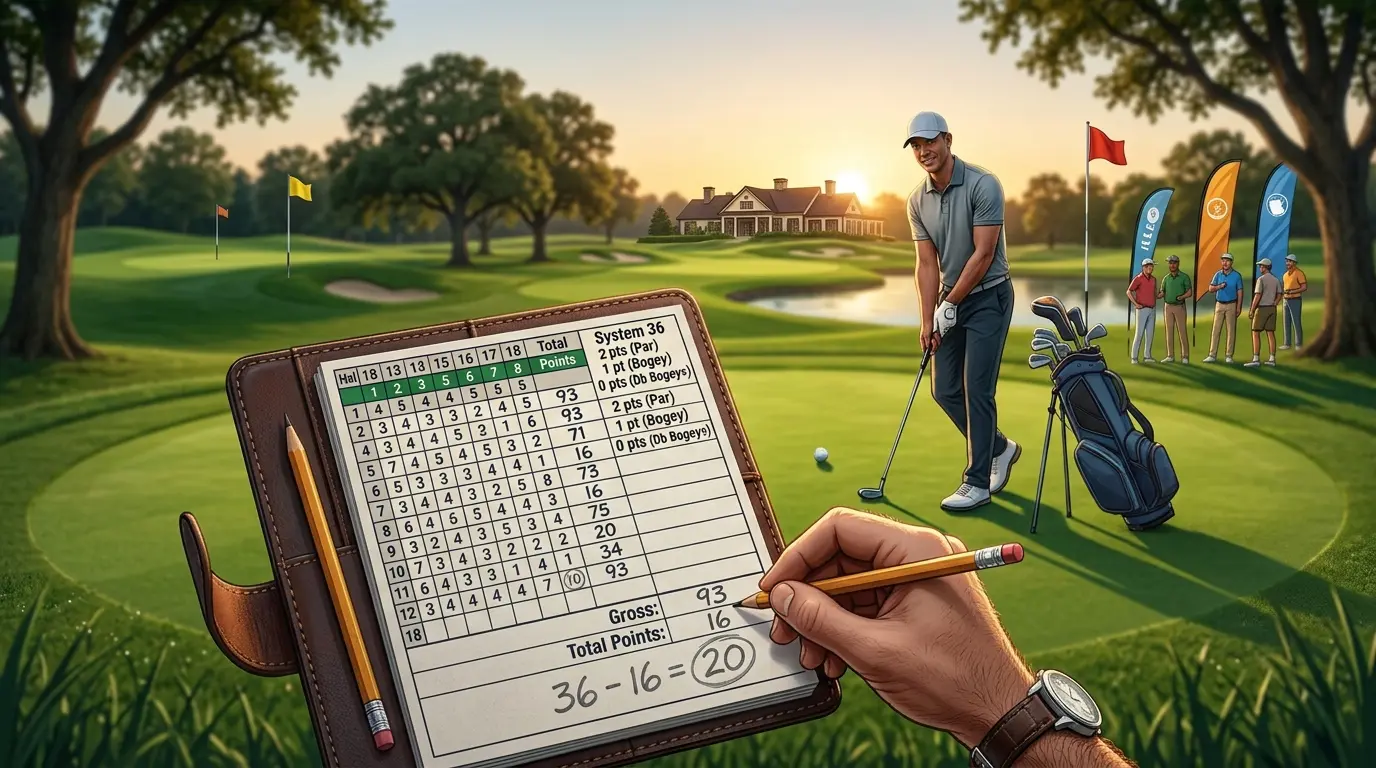
The Scoring: Two Points, One Point, None
Walk the card hole by hole and award points against par:
- Par or better — 2 points
- Bogey — 1 point
- Double bogey or worse — 0 points
Add the points up. Then:
Handicap = 36 − total points
That is the whole system. There is no Course Rating, no Slope Rating, no stroke index, and nothing to look up. An eagle scores the same two points as a par, which is the one place System 36 is blunt — more on that below.
A Full Round, Scored
Here is a complete 18 holes on a par 72. The player goes round in 93.
| Hole | Par | Gross | vs Par | Points |
|---|---|---|---|---|
| 1 | 4 | 5 | +1 | 1 |
| 2 | 4 | 6 | +2 | 0 |
| 3 | 3 | 3 | 0 | 2 |
| 4 | 5 | 6 | +1 | 1 |
| 5 | 4 | 6 | +2 | 0 |
| 6 | 4 | 4 | 0 | 2 |
| 7 | 3 | 4 | +1 | 1 |
| 8 | 5 | 7 | +2 | 0 |
| 9 | 4 | 5 | +1 | 1 |
| 10 | 4 | 5 | +1 | 1 |
| 11 | 4 | 7 | +3 | 0 |
| 12 | 3 | 3 | 0 | 2 |
| 13 | 5 | 6 | +1 | 1 |
| 14 | 4 | 5 | +1 | 1 |
| 15 | 4 | 5 | +1 | 1 |
| 16 | 3 | 4 | +1 | 1 |
| 17 | 5 | 7 | +2 | 0 |
| 18 | 4 | 5 | +1 | 1 |
| Total | 72 | 93 | +21 | 16 |
The quick way to check the points total without adding eighteen numbers is to count the holes by type. Three holes were par or better, ten were bogeys, five were double bogey or worse:
- 3 holes at 2 points = 6
- 10 holes at 1 point = 10
- 5 holes at 0 points = 0
That is 16 points from 18 holes, which agrees with the column.
So the handicap for the day is:
36 − 16 = 20
And the net score is the gross minus that handicap:
93 − 20 = 73
What the Number Means
A System 36 handicap of 20 is not a prediction about your golf in general. It is a description of the round you just played, and it will move around from card to card far more than a real Handicap Index does — because an Index averages your best eight rounds out of twenty, while System 36 has a sample of one.
Play the same course badly next week and System 36 will hand you a higher number and flatter you for it. That is the trade you make for not needing any history.
System 36 and Stableford Are the Same Card, Read Twice
The two look similar and are often confused, but they answer different questions.
Stableford needs a handicap before you start, so it can give you strokes on the hardest holes and score you against your net result. System 36 has no handicap to start with — it scores you against gross par and produces a handicap at the end.
The relationship is neat, and the card above shows it. Score that same round as Stableford off the handicap System 36 just produced — 20 — and it comes to 35 points, one short of the 36-point benchmark that means you played to your handicap. The strokes handed out add up to exactly 20, as they always should.
That is not a coincidence. System 36 is built so the handicap it produces lands you near the level you actually played at. It comes out slightly under here because System 36 is harsher: a double bogey scores nothing at all, while in Stableford a double bogey on a hole where you receive a stroke is still a net bogey and still scores.
If you want to see the same round scored both ways, the Stableford handicap calculator applies the strokes and allowance for you, and the gross Stableford calculator scores raw figures straight against par.
Where System 36 Falls Short
Three things are worth knowing before you rely on it.
It is not an official handicap. A System 36 number is valid for the competition it was worked out in. It cannot be entered on a scorecard at another club, it does not go into the World Handicap System, and it will not get you into an event that requires a verified Index. For that you need an official Handicap Index.
It ignores the difficulty of the course. Par is the only reference point. A 93 round a brutal championship layout and a 93 round a short municipal course produce the same handicap of 20, which is precisely what Course Rating and Slope Rating exist to correct. The Course Handicap calculator shows how much difference that correction makes.
It caps your good holes. An eagle and a par both score two points. A player who makes two eagles and a pile of double bogeys is rewarded no more than a steady bogey golfer, so System 36 tends to favour consistency over brilliance. For a society day that is arguably a feature rather than a fault.
Frequently Asked Questions
How do you calculate a System 36 handicap?
Award 2 points for a par or better, 1 point for a bogey and 0 for a double bogey or worse, on every hole. Add the points up and subtract the total from 36. If you score 16 points, your handicap for the day is 36 − 16 = 20.
Is System 36 an official golf handicap?
No. It is valid only for the competition it was calculated in. It does not go into the World Handicap System and it is not accepted as a verified Handicap Index elsewhere.
What is the difference between System 36 and Stableford?
Stableford requires a handicap before you tee off and scores your net result. System 36 requires nothing in advance, scores your gross result against par, and produces a handicap at the end of the round.
Why is it called System 36?
Because 36 is the number the handicap is subtracted from. A player who parred every hole would score 2 points on all 18 holes, making 36, and therefore receive a handicap of zero.
Does System 36 use the stroke index?
No. Points are awarded against the par of each hole, and the stroke index is never consulted. That is one of the reasons it is quick enough to work out in the car park.
Can System 36 give a handicap above 36?
No. The lowest possible points total is zero, which produces a handicap of 36, and that is the ceiling. A player who would genuinely need more than 36 strokes is not well served by this system.
Can I use System 36 over 9 holes?
Not directly. The arithmetic is built around 18 holes and the number 36. Some organisers halve it and subtract the 9-hole points total from 18, but that is a local convention rather than part of the system, so agree it with everyone before you start.
Is System 36 the same as the Callaway System?
No. Both produce a same-day handicap for players without one, but the Callaway System works by discarding a player’s worst holes according to a lookup table, while System 36 scores every hole and keeps them all.